
About this case study
This modeled workflow shows an operating cadence, not a reported growth result. It does not predict downloads, active users, retention, or revenue.
The app growth problem is often fragmented learning
A small team runs social posts, answers community questions, tests ads, and watches search traffic. Each activity may be reasonable, but the work is split across different tools and the insights rarely reach the next campaign brief.
That makes “growth” feel like a list of channels instead of a system. The team publishes because the calendar is empty, responds when a notification appears, and reviews performance only when someone asks for a report.
A stronger operating model begins with one audience problem, carries it through several distribution surfaces, and ends with a decision about what to repeat, change, or stop.
A five-part weekly growth cadence
The team can organize the week around one campaign and one audience question:
- Monday: review newly discovered Reddit leads and note the problem language, objections, and repeated workarounds behind the strongest matches.
- Tuesday: use Content Producer to rank relevant subreddits, inspect evidence and posting windows, and prepare text drafts for human review.
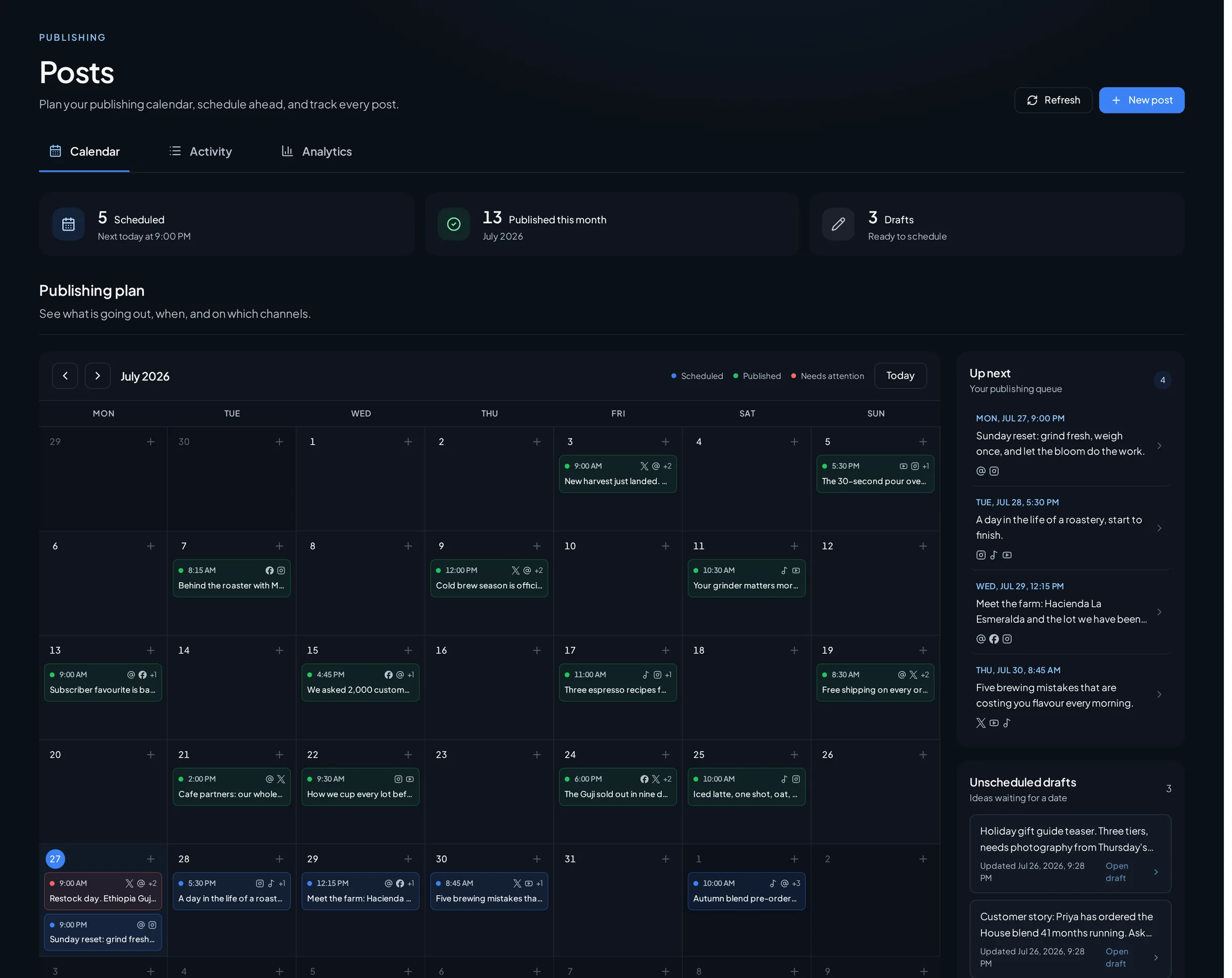
- Wednesday: adapt the strongest lesson into platform-appropriate social posts, then schedule them across compatible connected accounts.
- Thursday: review replies and supported social comments, respond where the team can add useful context, and record new questions for the next brief.
- Friday: compare search and paid performance over a consistent window, then choose one message to keep, one to revise, and one experiment to stop.
Turn channel activity into a feedback loop
The lead queue shows what people say before they visit. Comments and replies show what they question after seeing the message. Search Console shows the queries and pages that already earn impressions or clicks. Paid reporting shows where spend and delivery changed.
These signals are not interchangeable. A Reddit reply is qualitative evidence, a social comment reflects a platform audience, and provider metrics use their own definitions. The team should compare patterns without pretending every number belongs in one attribution model.
The useful output of the Friday review is a smaller next week: one audience, one problem, a few channel-specific assets, and a clear reason for running the next experiment.
The modeled operational outcome
Five disconnected growth activities become one repeatable week with a shared campaign brief and a defined feedback point. The team can explain why it is creating each asset and which signal will inform the next iteration, even when user growth itself remains uncertain.
The growth metric guardrail
Reach, clicks, and leads are intermediate signals. Pair this workflow with product analytics for activation, retention, referrals, and revenue so the team does not optimize distribution while the product experience leaks users.
Frequently asked questions
What is the most important part of growing an app?
Sustainable app growth requires both acquisition and retention. This workflow improves the acquisition learning loop, but product analytics and user research are still needed to understand activation and ongoing value.
Which growth channel should a small app team start with?
Start where the target user already describes the problem in public and where the team can participate credibly. Use early response quality and product activation—not reach alone—to decide whether to expand.
Can one piece of content be published unchanged everywhere?
Usually not. The underlying insight can be reused, but media rules, text limits, audience expectations, and calls to action vary by platform. Adapt the asset where those differences matter.
How quickly should the team judge a growth experiment?
Use an evaluation window appropriate to the signal. Conversation response can appear quickly, while SEO and retention need longer observation. Define the window before the experiment so a slow channel is not judged by a fast-channel clock.