
About this case study
This guide describes a repeatable process, not a reported customer result.
Why distribution is the bottleneck in 2026
You can describe an app to Lovable, Bolt, Cursor, v0 or Replit in the morning and have it deployed by the evening. Work that used to need a funded team and a quarter now needs a weekend and a credit card. That is a real change, and it has an obvious second consequence: the number of finished apps is growing much faster than the number of people looking for one.
Scarcity moved. It used to sit in engineering, so the founders who could ship had an advantage by default. It now sits in attention. Shipping is table stakes; being found is the hard part. The skill that separates an app with users from an app without them is no longer the ability to build, it is the ability to put the thing in front of the right people, repeatedly, without burning out.
Most founders meet this as one deflating moment. The app works. The landing page is live. Payments are wired up. The analytics chart is a flat line at zero and nothing is technically wrong. Nobody knows the app exists, and no error message will ever tell you that.
The instinct is to go back to the editor. Another feature is a familiar problem with a known solution and a satisfying feedback loop. Distribution is an unfamiliar problem with no obvious first step, so it gets postponed until the next release, which never quite arrives. Six months later there is a very polished app with four users, three of whom are friends.
The reframe that unblocks people: distribution is not a launch. A launch is a single day and mostly a lottery ticket. Distribution is a system you run every week, which compounds, and which you can debug with the same instincts you already apply to code. The rest of this guide is that system.
The four parts of a distribution system
When founders say “I need to do marketing,” they usually collapse four separate jobs into one intimidating blob. Separate them and each becomes small enough to start this week. A distribution system has exactly four moving parts: audience, channels, cadence, and feedback.
Audience is the group narrow enough that you can picture one specific person in it and predict what annoys them. “Developers” is not an audience. “Solo developers who ship side projects and dread writing about them” is. The narrow version tells you what to say; the broad version tells you nothing, which is why writing for everyone feels like writing into a void.
Channels are the places that audience already spends attention. You do not get to pick them based on which app you personally enjoy. If your users argue about the problem in a subreddit, that subreddit matters more than the network with the nicest analytics.
Cadence is how often you show up, and it is the part that decides whether the system works at all. Distribution rewards frequency far more than polish. Three ordinary posts a week beat one immaculate post a month, because the third post is the one that reaches the person who was not paying attention during the first two.
Feedback is the loop that stops this from being guesswork. You watch which posts earned replies, which words people repeated back to you, which landing-page visit turned into a sign-up, and you feed that into next week. Without feedback you are not running a distribution system, you are running a hobby.
Most stalled founders have none of the four. Most founders who feel busy but flat have three of them and are missing cadence.
Choose channels by where your users already are
The channel question has a boring, correct answer: go where your users already are, not where you are comfortable. The way to find out is to write down the last three places you saw someone describe your app’s problem in their own words. Those are your first channels. Everything else is a hypothesis.
It also helps to be honest about which channels you can automate and which need you in the room. Amplispect publishes to Instagram, Threads and X: you review the week, approve the posts, and they go out on schedule without you opening three apps. That covers the steady drumbeat, which is precisely the part that collapses when it depends on daily willpower.
Reddit, LinkedIn, Product Hunt and TikTok stay manual, and that is the right call rather than a limitation. Reddit punishes anything that reads like a broadcast; you have to be a participant with history in the community. LinkedIn rewards a personal voice and replies in the first hour. Product Hunt is a single coordinated day, not a cadence. TikTok needs your face. Automate the drumbeat, do the rest by hand, and stop feeling guilty about the difference.
Two channels done consistently will beat six done once. Pick a maximum of three to start, one automated and one manual, and add another only after the existing ones have run for a month without you missing a week. The cost of a channel is not the posting, it is the attention it takes from the channel that was already working.
Build your channel shortlist
Spend one sitting picking channels, then leave the decision alone for a month:
- Write the problem your app solves in the words a user would use, not the words your landing page uses.
- Search that phrasing and note the three places where real discussions are already happening.
- Pick one automated channel from Instagram, Threads or X, whichever your audience actually reads.
- Pick one manual channel where you can be a genuine participant, usually Reddit, LinkedIn or TikTok.
- Park Product Hunt as a dated event rather than a channel, and plan it once the other two are running.
- Write down what would make you drop a channel, so you stop it deliberately instead of letting it die quietly.
The weekly operating rhythm
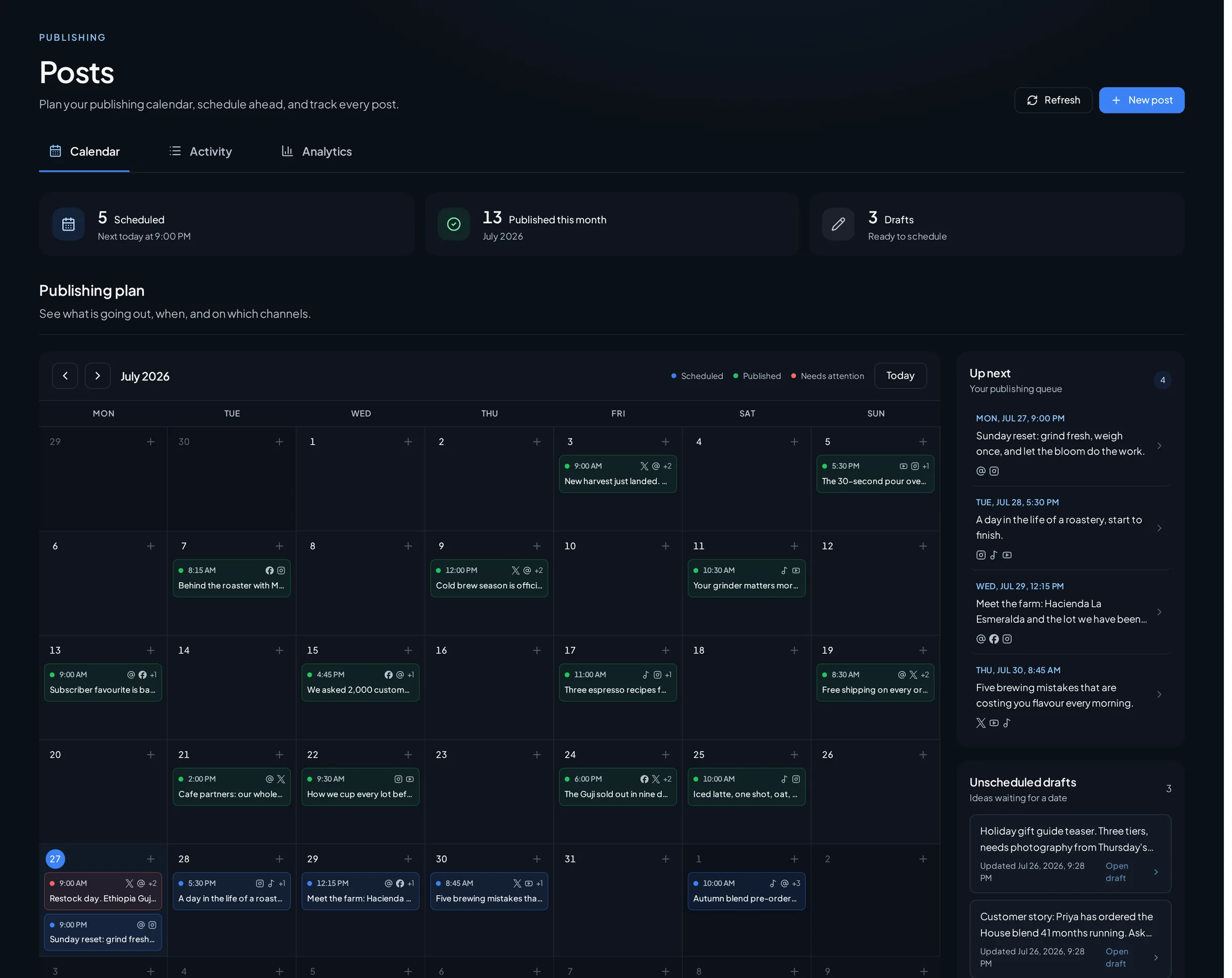
Once it is running, the whole system fits into a few hours a week. A workable rhythm looks like this:
- Monday, 30 minutes: review the generated week of posts, cut anything that sounds like an ad, and approve the rest so the schedule is closed before the week starts.
- Tuesday to Friday, 10 minutes a day: reply to every comment and mention you get. Replies compound faster than posts do.
- Midweek, 45 minutes: one action on a manual channel, whether that is a genuinely useful Reddit answer, a LinkedIn post, or a short video.
- Whenever you ship: turn the change into a post the same day, while you still remember why it mattered. Shipped work is your cheapest content.
- Friday, 20 minutes: note in one line each which posts earned replies or saves and which fell flat.
- Friday, 10 minutes: compare sign-ups and activation against the week before, and write down the one number you want to move next week.
- Once a month, 1 hour: drop the worst-performing content format, keep the best, and decide whether to add a channel.
What to measure, and what to ignore
Early distribution generates a lot of numbers and almost none of them mean anything. Impressions, follower count and likes move for reasons that have nothing to do with your app: an algorithm test, a hashtag, someone large resharing you once. Optimising for them teaches you to write posts that perform instead of posts that sell.
Measure four things instead. Replies and saves, because they mean someone recognised their own problem. Clicks to the landing page, because that is intent. Sign-ups from those clicks, because that is your landing page grading itself. And activation, the share of sign-ups who reach the moment the app is genuinely useful, because a distribution problem and an onboarding problem look identical from the outside and only this number tells them apart.
Read those numbers weekly and act on them monthly. Weekly, because a week is short enough that you still remember what you did; monthly, because any single week is mostly noise and you would otherwise rewrite your whole strategy every Friday. When a number moves, write down the change you made before it moved. That note is worth more than the dashboard.
One more thing worth ignoring: other founders’ numbers. A screenshot of a spike shows you the output of a system you cannot see, usually after months of work nobody screenshotted. Compare this week against your own last week instead. It is the only comparison with enough shared context to teach you something you can act on.
What a working system actually looks like
After a month you are not famous. You are something more useful: predictable. Posts go out on a schedule you set, three or four conversations a week start with someone describing your own problem back to you, and you know which channel produced your last ten sign-ups. That is the point where distribution stops being an anxiety and becomes a dial you can turn. Growth still depends on the product being worth using; the system only makes sure the right people get the chance to find that out.
The guardrail
Consistency is not permission to broadcast. Nothing should publish without you reading it, automated channels included, because an unreviewed post is exactly how a brand voice quietly turns into spam. Do not paste the same launch link into every subreddit, do not treat communities as a mailing list, and never promise numbers you cannot control. A cadence that annoys people is worse than no cadence at all: it burns the audience you were trying to build.
Start here
Every part of the system above has its own guide. Read them in the order that matches where you are stuck.
- I Built an App With Lovable, Bolt or Cursor. How Do I Get Users?The first move when the app is finished and the user count is still zero.
- Why Nobody Is Using Your App (and the Distribution Gap Behind It)How to tell a distribution problem apart from a product problem before you rebuild anything.
- App Marketing for Developers Who Hate MarketingA version of marketing that works if you would rather be writing code.
- How Much Time Should a Solo Founder Spend on Marketing vs Building?How to split a week between shipping features and finding users without losing both.
- Product Hunt Launch Checklist for Indie Apps (2026)What to prepare before, during and after a Product Hunt launch day.
- How to Launch an App on X, LinkedIn, Reddit and TikTok in the Same WeekA one-week plan for launching on X, LinkedIn, Reddit and TikTok without repeating yourself.
- Build in Public: A Posting Cadence That Gets Users, Not Just FollowersHow often to post while you build, and what to say in the weeks nothing shipped.
- ASO vs SEO vs Social Media: Where Should a New App Spend Its First Month?Where a new app should spend its first month of attention, and what can wait.
- Turn Your Landing Page Into 30 Days of Social PostsTurn the page you already wrote into a month of posts you do not have to invent.
- How to Write a Changelog That Brings Users Back (and Attracts New Ones)How to write release notes that bring users back instead of disappearing into a tab.
- Your First 10 Posts About Your App When You Have No Users or TestimonialsTen specific posts to publish when you have never written about your app before.
- Best Distribution Tools for Indie Apps in 2026The tools worth paying for as a solo founder, and the ones you can skip.
- Typefully vs Amplispect for Build-in-Public FoundersA direct comparison for founders choosing a build-in-public publishing tool.
- App Launch Content Calendar Template: 3 Weeks, Day by DayA dated calendar you can copy for the two weeks around a launch.
- Build in Public Content Calendar Template: A Repeatable 4-Week PlanA repeatable weekly calendar for posting while you build.
Foundations
Longer-standing guides on the parts of distribution that do not change.
- How to Get the First 100 Users for Your AppThe targeting work behind the first hundred people who use your app.
- How to Grow Your App With a Weekly Acquisition LoopHow a weekly acquisition loop keeps growth from depending on one good week.
- How to Improve SEO for Your App Without GuessingSearch work a small app can do without a content team or an agency.
- How to Find the Target Audience for Your AppHow to narrow a vague audience into a group you can actually write for.
- How to Get Beta Testers for Your AppWhere to find testers who give you usable feedback instead of polite praise.
- How to Market Your App on Reddit Without SpammingHow to be useful on Reddit without getting removed by a moderator.
- How to Promote Your App on Social MediaThe mechanics of promoting an app on social without sounding like an ad.
- Content Marketing Strategy for Your AppHow content compounds attention for an app over months rather than days.
Set up the system
The product pages behind the automated half of the rhythm above.
- Turn your website into a workspaceAmplispect reads your site to learn your offer, audience and brand voice before it writes anything.
- Generate a planned week of postsA week of posts on your cadence, each with a role and a date, ready for you to review.
- Schedule and publish to Instagram, Threads and XOne composer with per-network previews, validation and publish status for every destination.
- Start your first weekCreate a workspace and get the first planned week in front of you.
Frequently asked questions
How do you distribute an app after building it?
Start with one narrow audience, pick two or three channels where that audience already talks about the problem, publish on a fixed weekly cadence, and review what earned replies at the end of each week. Distribution is a weekly system, not a launch day.
What is the best app distribution strategy for a solo founder?
The one you can keep doing. In practice that means automating the steady posting on one or two networks, reserving a few hours a week for a manual channel where you can be a real participant, and refusing to add channels until the existing ones run without a missed week.
How long does it take to get users for a new app?
Longer than one launch day and shorter than most founders fear. A month of consistent cadence is usually enough to see which channel and which message earn replies. It is not enough to guarantee sign-ups, which also depend on the product, the landing page, pricing and onboarding.
Which channels can Amplispect publish to?
Amplispect plans, schedules and publishes to Instagram, Threads and X, with a preview and validation per network and nothing going out without your review. Reddit, LinkedIn, Product Hunt and TikTok are described here as manual work you do yourself.