
About this case study
This is a modeled weekly schedule you can copy and adjust, not a reported customer result or a promise that a given number of hours produces users.
There is no 50/50 rule
The question comes up every week in indie hacker forums: how much time should I spend on marketing versus building? The popular answer is 50/50, and it is wrong in the way that every fixed ratio is wrong. A fixed split assumes the distribution work stays the same size all year, when in reality it changes shape at least three times in the first months of an app.
The 2026 version of the question is different anyway, because the build half has collapsed. You can go from an idea to a deployed, working app with Lovable, Bolt, Cursor, v0 or Replit inside a weekend. The bottleneck moved. Spending half your week building when the app already does the thing is not balance, it is a comfortable place to hide.
So here is the opinionated answer. Pre-launch: roughly 80 percent building, 20 percent distribution, about 6 hours a week on distribution. Launch week: 30 percent building, 70 percent distribution, about 20 hours. Post-launch plateau: 60 percent building, 40 percent distribution, about 12 hours. The exact percentages matter far less than the fact that they move, and that you know which stage you are standing in.
The three sample weeks below assume roughly 30 focused hours. If your real week is 12 hours around a job, scale every line down and keep the ordering. What you should not do is average the three stages into one comfortable number and call it a strategy.
Pre-launch: 6 distribution hours
You are not selling yet. You are collecting an audience of roughly the right shape and learning the words they use, so launch week has somewhere to land.
- 2 hours, Monday, one sitting: generate the coming week of posts from your workspace, read every one, rewrite what sounds like a brochure, delete what is not true yet, and schedule the rest to Instagram, Threads and X.
- 1 hour: write one longer piece about the problem, not the product, and put it where your audience already reads.
- 1 hour: ten genuine replies to other people in your niche. No links, no pitch, no reason for anyone to feel sold to.
- 1 hour: talk to two people who have the problem. A DM, a call, or a thread under a competitor complaint all count.
- 30 minutes: update the landing page so it describes what you actually built this week.
- 30 minutes total, five to ten minutes a day: reply to comments on your own posts.
- 24 hours left for building, which is more than most founders think they get.
Launch week: 20 distribution hours
This is the one week where building loses on purpose. Freeze the code the Friday before and touch it only for launch-breaking bugs.
- 4 hours the weekend before: generate and edit the entire launch week in one sitting, every day, all three networks, with the launch-day posts written last and hardest.
- 2 hours: prepare the things that are not posts. The demo video, three screenshots, and the one paragraph you will paste into every directory form.
- 3 hours on launch day, replies only: every comment, quote and DM answered inside the hour, because that hour is when the algorithm and the humans are both paying attention.
- 2 hours a day for the rest of the week, in two blocks: replies, follow-ups, and the people who said "interesting, ping me later".
- 2 hours: the manual channels no scheduler publishes for you. A Reddit post in a community where you are already a regular, a LinkedIn post, a Show HN, an email to everyone who ever asked about it.
- 1 hour Friday: write down in plain sentences what earned a response and what did not, so the next week is not guesswork.
- 10 hours for building, which realistically means bug fixes, onboarding copy, and the one thing three people asked for.
Post-launch plateau: 12 distribution hours
The spike is gone, the graph is flat, and this is the stage where most solo founders quietly stop posting. The schedule exists to make stopping harder than continuing.
- 2 hours, Monday, one sitting: review, edit and schedule the generated week. This is the only session in which you open the calendar at all.
- 3 hours: one substantial thing a week, such as a changelog post, a teardown, or a short guide, written so it can be cut into several posts later.
- 2 hours: distribution the scheduler does not do. One community, one newsletter swap, one podcast pitch, one partnership email.
- 2 hours: talk to five people who signed up and never came back. Ask what they expected to happen.
- 2 hours Friday: read the performance view, note which post role earned replies, and let next week reflect it.
- 1 hour total, ten to fifteen minutes a day: replies and comments, nothing else.
- 18 hours for building, and now build what those five conversations told you to build.
Why one review session beats posting daily
The reason the 50/50 argument never resolves is that people compare hours without comparing shapes. Four hours of building is one block. Four hours of distribution done by hand, a little each day, is fifteen context switches, and every switch costs you the state you were holding about the code. The hours look equal on a timesheet and are not equal in your head.
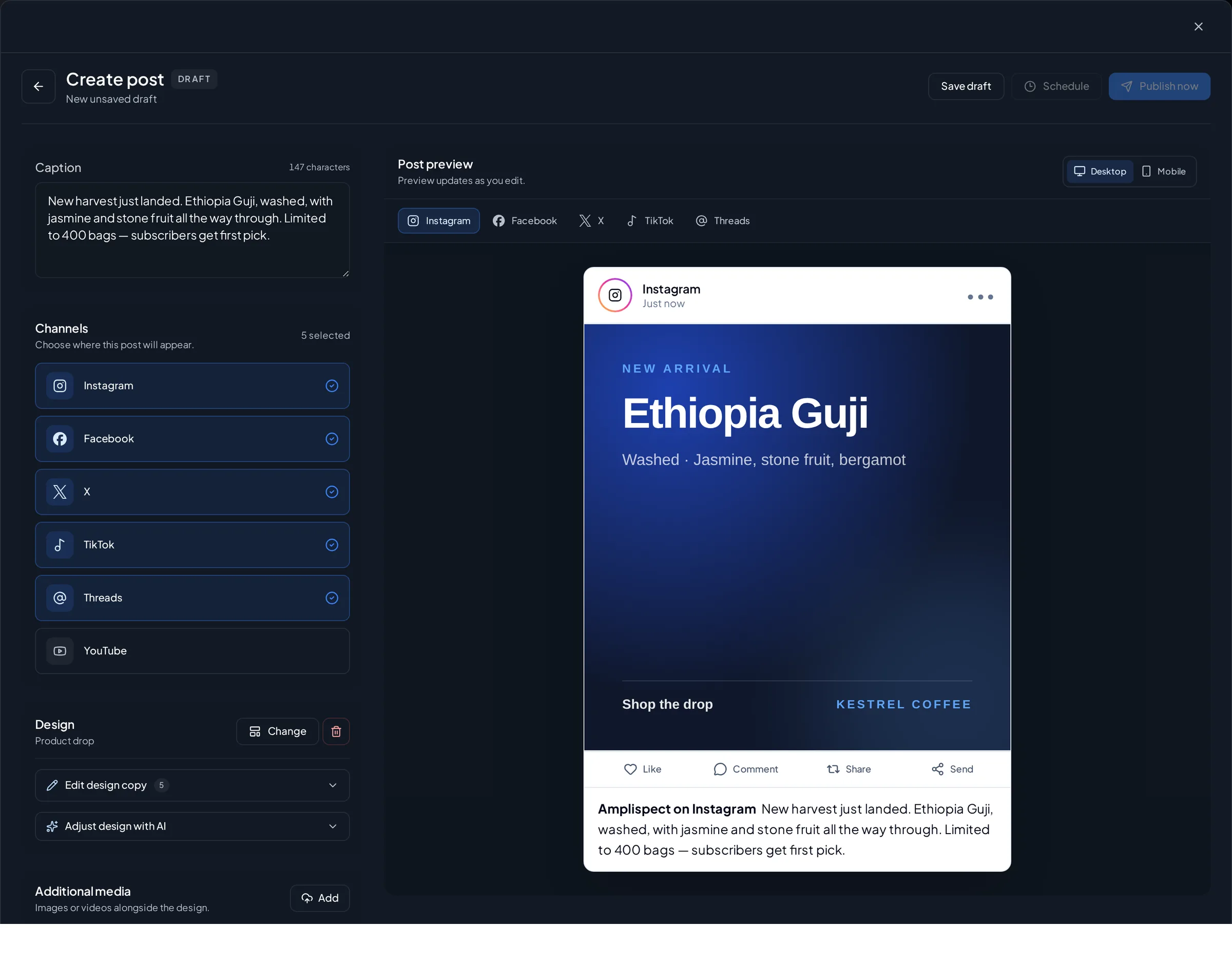
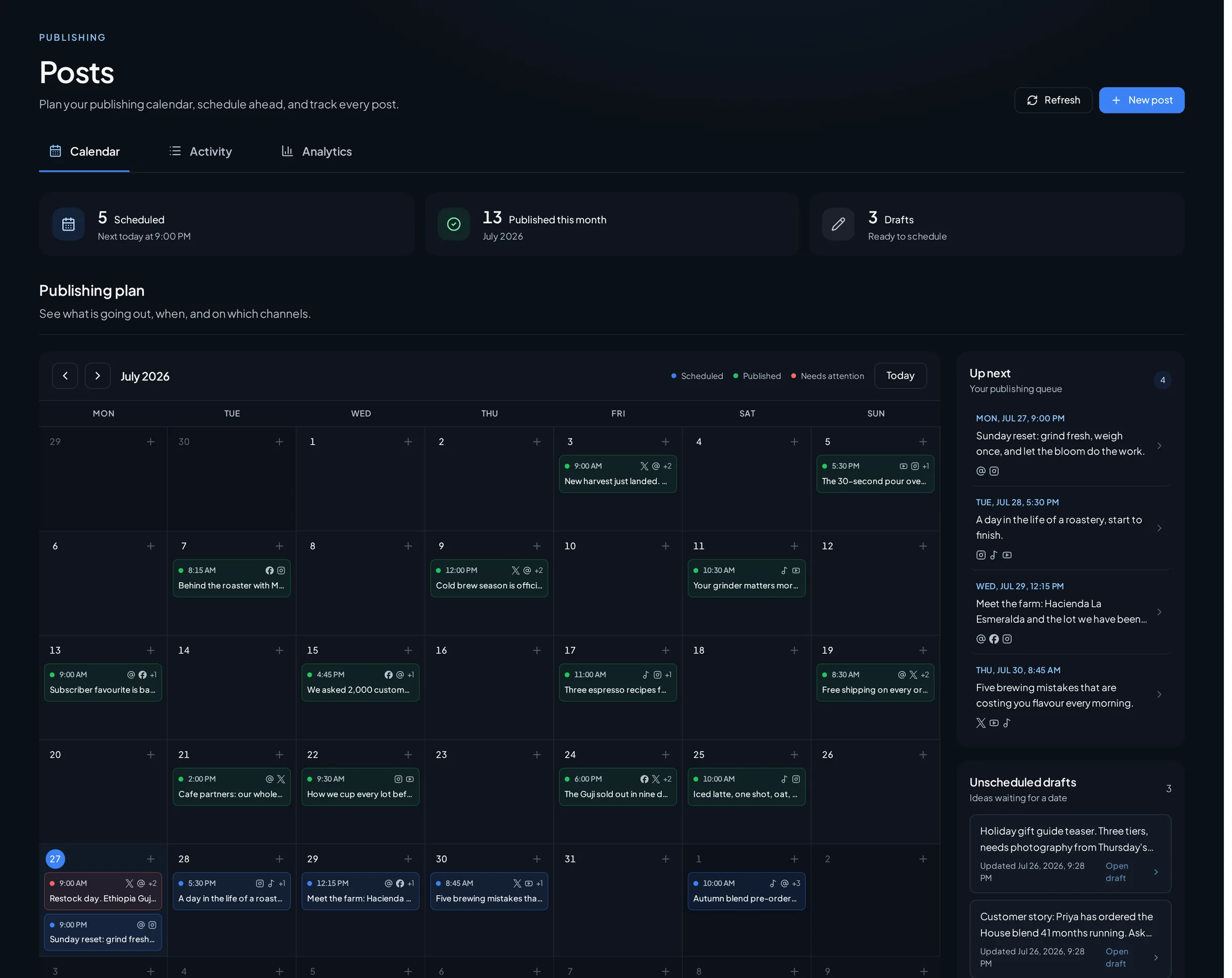
So collapse them. Amplispect builds a workspace from your website, picking up your offer, your audience and your brand voice, then generates the coming week of posts on the cadence you set, each with a role and a date. You open that week once, read every post, rewrite the flat ones, delete the ones that are not true yet, and schedule what survives. Per-network previews and validation mean you catch the caption that breaks on X before it queues, not after.
That is the two-hour Monday line in each of the three weeks above. Everything left in the distribution column is either work a tool genuinely cannot do for you, such as the DMs, the community post and the user calls, or the daily ten minutes of answering people who replied. Comments from supported networks sync back into the same workspace and can be answered from reviewed drafts, which keeps the daily block a block instead of a tour of three apps.
Nothing publishes without you reading it first. That is the whole trade: the schedule protects your building hours by making the distribution hours predictable and bounded, not by taking your name off the posts.
What the schedule actually buys you
A month in, you have a distribution habit that survives a bad week: one review session you can defend on a calendar, a daily ten minutes cheap enough to keep, and a written record of which posts earned replies. That is a compounding practice and a real answer to the time question. It is not a traffic number, and no schedule can promise you one.
A calendar is not demand
Posting on schedule does not create demand for an app nobody needs. If eight consistent weeks produce no replies, no sign-ups and no questions, the schedule is working correctly and telling you something useful: the problem is the offer, the audience or the app. Change one of those before you add posting hours.
Go deeper
The rest of the cluster, if you want the parts this schedule assumes you already have:
- App Marketing for Developers Who Hate MarketingWhat to do with the distribution hours when the work itself is the part you dread.
- Build in Public: A Posting Cadence That Gets Users, Not Just FollowersA cadence for the generated week, so the posts have something honest to say on a quiet Tuesday.
- How to Distribute an App: The Complete Guide for Founders Who Have Built SomethingThe full picture of how an app finds users once it is built and deployed.
- How to Grow Your App With a Weekly Acquisition LoopThe same weekly rhythm once there is more than one of you doing the work.
- Why Nobody Is Using Your App (and the Distribution Gap Behind It)What to check first when the plateau week never turns into growth.
- The schedulerReview, validate and schedule a week for Instagram, Threads and X in one sitting.
- Start a workspaceBuild a workspace from your website and see the first generated week.
Frequently asked questions
How much time should an indie hacker spend on marketing?
It depends on the stage, not on a fixed ratio. Roughly 20 percent of your week before launch, up to 70 percent during launch week, and around 40 percent once the launch spike flattens. In a 30-hour week that is about 6, 20 and 12 hours respectively.
Is the 50/50 rule for building and marketing real?
It is a useful slogan and a poor schedule. A fixed split ignores that launch week needs far more distribution than the month before it, and that a plateau needs more than a pre-launch build. Move the ratio with the stage instead.
Can I do app marketing in a few hours a week as a solo founder?
Yes, if you batch it. Generating and reviewing a week of posts in one sitting, then spending ten minutes a day on replies, is a realistic few hours. What does not fit into a few hours is inventing every post on the day you publish it.
What if I post consistently and still get no users?
Then the schedule has done its job by removing consistency as the explanation. After roughly eight weeks with no replies, sign-ups or questions, look at the offer, the audience definition and the app itself before adding more posting time.