
About this case study
This models a sustainable posting routine for an owner-operator. Consistency is an operational outcome; bookings, foot traffic, and enquiries depend on the business, its offer, and its market.
The real constraint is the owner’s calendar
A studio owner, a clinic manager, or a restaurant operator does not stop posting because they run out of ideas. They stop because Tuesday gets busy, then Wednesday does, and by Friday the account has been quiet for two weeks and restarting feels like a project.
Advice written for marketing teams makes this worse. Daily posting across six networks is not a plan for someone whose actual job is serving customers; it is a plan for feeling behind.
The workable version is narrower: two or three channels the customers genuinely use, four posts a week, and all of the decision-making compressed into one session that happens at the same time each week.
The Monday hour
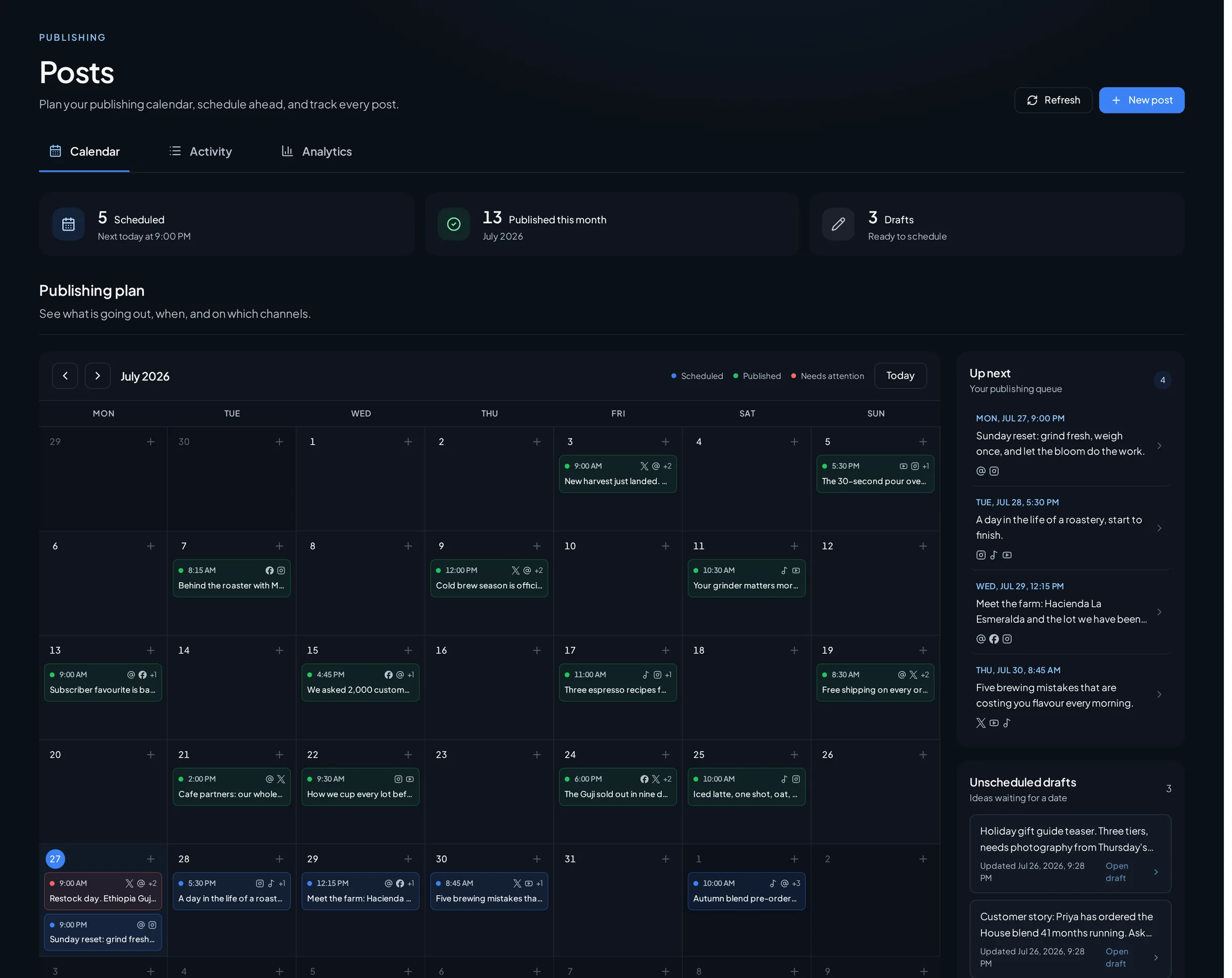
One session produces the whole week:
- Connect only the channels that matter locally — for most service businesses that means Instagram and Facebook, sometimes one more.
- Photograph or collect the week’s raw material in a single pass: the work itself, the space, the team, a finished result, an answer to a question customers keep asking.
- Write four posts against a fixed weekly shape rather than a blank page — something useful, something behind the scenes, something being offered, something proving the work.
- Drop each one into a saved design template so the posts look related without any layout decisions.
- Schedule all four across the week, check the destinations, and close the app until there are replies to answer.
What stays a daily job
Scheduling removes the production work, not the conversation. For a local business the replies are frequently the part with commercial value — questions about opening hours, availability, price, or whether a service covers a specific need.
Supported comments can be pulled into one queue, which turns a scattered daily obligation into a few minutes of focused work. Drafted replies still need a human read, and for a local business the tone is the differentiator, so this is not the step to automate away.
Publishing status is worth a glance rather than a routine. Because each destination reports separately, a failure on one channel is visible without checking the others, and it can be fixed without touching a post that already went out correctly.
The modeled operational outcome
One weekly hour produces four scheduled posts across the right channels, and the daily commitment shrinks to replies. The outcome is a cadence the owner can actually sustain through a busy month — not a promise of more bookings.
The guardrail for local accounts
Do not batch away the timely posts. A cancellation opening up, a same-day special, or a response to something happening locally beats anything scheduled a week earlier, and the calendar should leave room for it.
Frequently asked questions
How many channels should a local business use?
Two or three, chosen by where local customers already look. A consistent presence on two channels is worth considerably more than a neglected account on six.
Is four posts a week enough?
For most local service businesses, a sustained four is better than a burst of daily posting followed by a silent month. Set the number at whatever survives a busy week.
What should a local business post about?
The work itself and the questions customers keep asking. Finished results, the space, the team, and clear answers about availability or pricing tend to travel further locally than general industry commentary.
Can the whole week be scheduled in advance?
Yes, and it should be — but leave a gap for anything timely. Scheduling covers the routine posts so that attention is available for the ones that cannot be planned.