
About this case study
This guide describes a repeatable two-week process, not a reported customer result or a promise that a specific number of people will sign up.
Your build tool solved the wrong half of the problem
You described what you wanted, an AI build tool wrote it, and by Sunday night the thing was deployed on a real domain with auth, a database and a payments page. It works. You have used it yourself all week. And the analytics tab has been showing the same number since launch: you, on three devices.
That is not a failure of the app. Lovable, Bolt, Cursor, v0 and Replit compressed the part of shipping that used to take three months into a weekend. What they did not compress is the other half of shipping: convincing one stranger that the thing is worth opening, then a second one, then thirty.
That half did not get cheaper, because it was never a code problem. Distribution is one person explaining a specific problem to people who have that problem, in the places where those people already complain about it. No build tool does that for you, and no amount of extra features substitutes for it.
The useful news is that it is a smaller job than it looks from the outside, and most of the outcome is decided in the first two weeks — not by how much you post, but by how narrowly you aim. What follows is a fortnight you can actually run alongside a day job.
Week one: pick one user, one problem, one page
Before you post anything anywhere, narrow the target until one sentence can hold it:
- Name one person who has this problem today. Not “small businesses,” but “a solo dog groomer who books clients over WhatsApp and loses half the messages.”
- Write the problem the way they would say it out loud, complaint first, with no product vocabulary in it.
- Write down who the app is explicitly not for, so you can walk past conversations that will never convert.
- Cut the landing page headline down to that problem sentence, and put the outcome in the line underneath it.
- Replace every feature name with the words your user actually used: “stop chasing late invoices,” not “automated receivables workflow.”
- Leave exactly one action above the fold, and open the page on a phone before you believe it works.
- Add one line saying who built this and why, because at this stage people are buying from you, not from a brand.
Set up a presence that does not eat your build time
The reason most weekend-built apps go quiet in week three is not laziness. It is that writing posts competes directly with the work that feels productive, and building always wins that argument. So the presence has to cost you minutes, not evenings, or it will not survive contact with a real week.
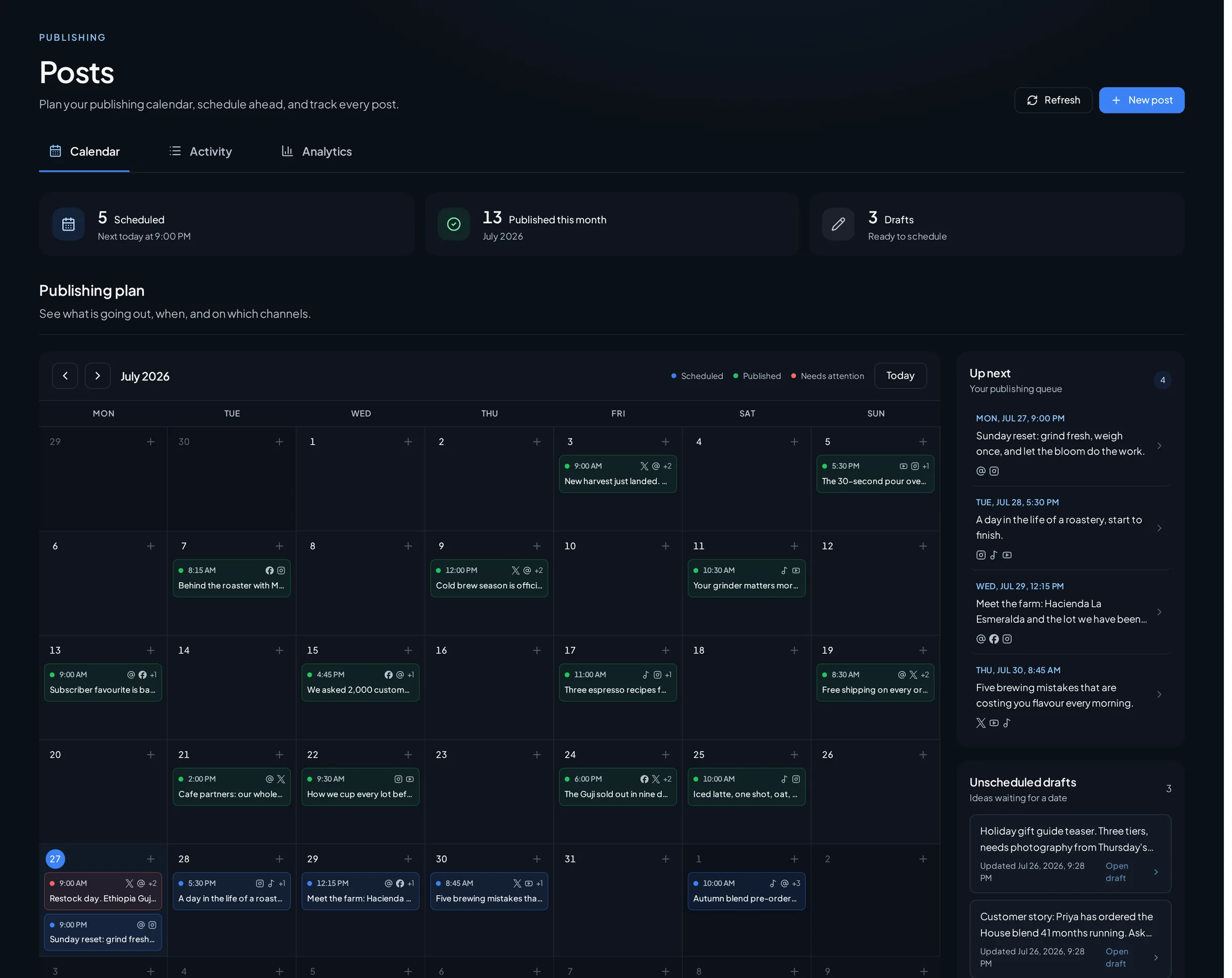
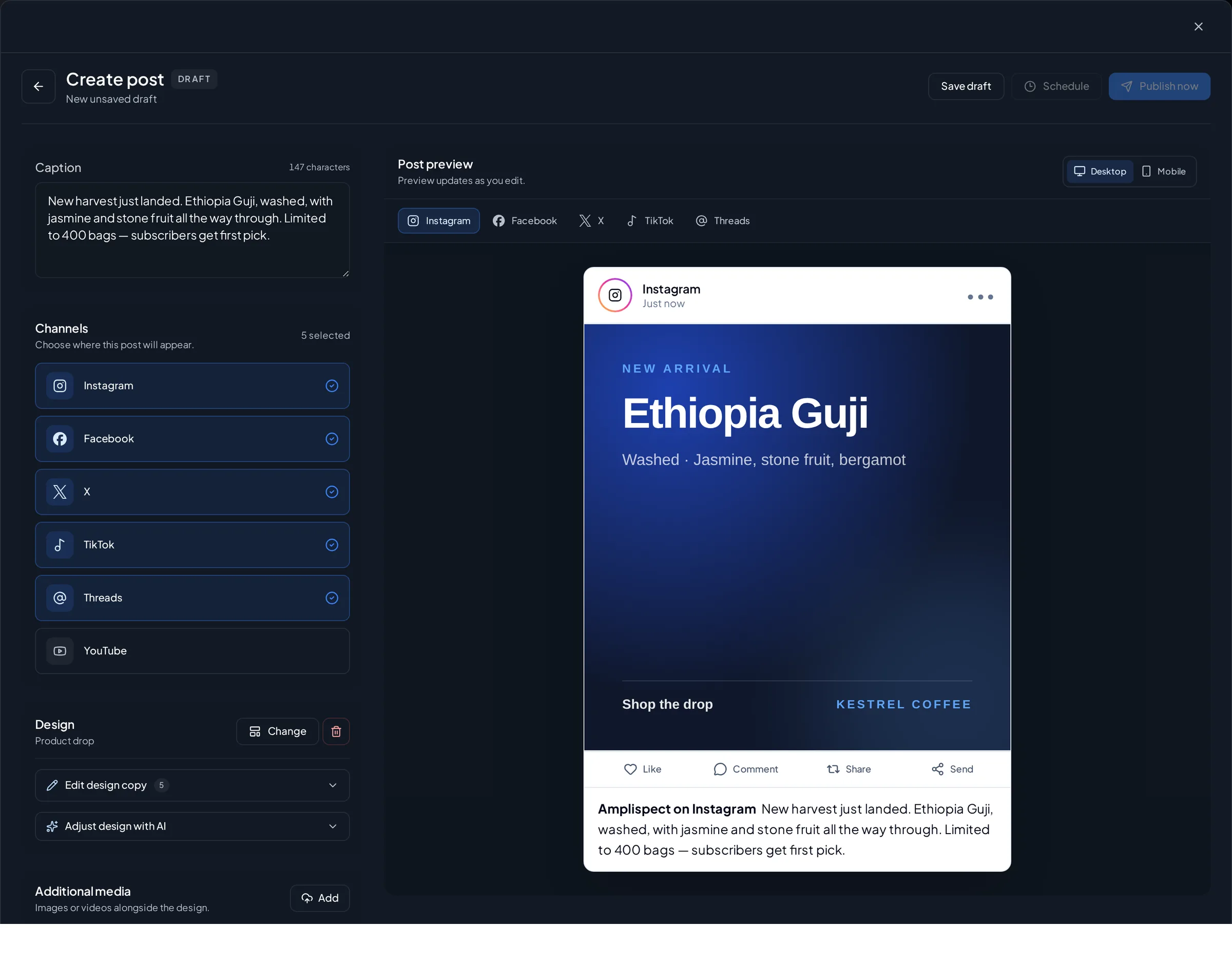
This is the part Amplispect is for. It reads your site and builds a workspace from it — the offer, who it is for, the voice you already write in — so you are not starting from an empty box every Monday. From there it drafts a week of posts on a cadence you set, each one with a role and a date, for Instagram, Threads and X.
Nothing goes out on its own. You open the week, delete what is wrong, rewrite the line that does not sound like you, and approve the rest with a per-network preview in front of you. Budget twenty minutes once a week for that review, and treat it as fixed as a deploy.
Three channels is the honest scope: Instagram, Threads and X are what the product publishes to. Every other place on your list — Reddit, Discord, a niche forum, a newsletter you read — is manual work that you do with your own hands, which is the next section and the more important one.
Week two: show up where those users already talk
Scheduled posts build a record people can check. Conversations are what actually produce the first users, and this part stays manual on purpose:
- List five places your one user genuinely reads: two subreddits, two Discord or Slack communities, one niche forum or newsletter.
- Spend the first three days replying only, with no links and no app name, until you can predict which answers get upvoted.
- Answer the exact question in public and in full, so the reply is useful even to someone who never clicks anything.
- Mention the app only in threads where it honestly is the answer, and say plainly that you built it.
- Read each community's self-promotion rules before your first post rather than after your first removal.
- Message the three people whose complaint matched your problem sentence almost word for word, and ask what they use today.
- Keep a running note of the phrases they use. Those become next week's posts and, eventually, the headline on your page.
Measure replies and sign-ups, not impressions
At this stage impression counts will lie to you. A post can reach four thousand people and mean nothing, while a reply in a thread of eleven people can produce your third paying user. Big numbers early are usually a sign that you reached the wrong crowd, not a sign of progress.
Track four things and nothing else: replies from accounts that are not bots, clicks through to the site, sign-ups, and how many of those people opened the app a second time. One line in a note, once a week. The second-open number is the one that tells you whether the product is worth distributing harder.
Fourteen days is enough time to learn which problem sentence earns a reply. It is not enough time to conclude that the app has no market. If nothing landed, change the sentence and the page before you change the product — the copy is far more likely to be wrong than the code your build tool wrote.
What fourteen days can realistically produce
By the end of the fortnight you can reasonably have: one defined user, a landing page written in their language, a reviewed week of posts going out on a cadence you can keep, five communities where people recognise your name, and four honest numbers to compare against next week. That is a distribution habit, which is the thing that compounds. It is not a guaranteed number of sign-ups, and no tool can promise you one.
The guardrail
Do not try to automate the community half. Amplispect publishes to Instagram, Threads and X after you review each post, and it does not post to Reddit, Discord or forums — deliberately. Dropping generated replies into communities is the fastest way to get your app banned from the exact places your first users live, and that ban is far harder to undo than a slow week of posting.
Go deeper
The rest of the distribution playbook, roughly in the order you will need it:
- How to Distribute an App: The Complete Guide for Founders Who Have Built SomethingThe full guide to distributing an app, from first user to a repeatable weekly motion.
- Your First 10 Posts About Your App When You Have No Users or TestimonialsTen specific posts to write when you have shipped something and have no idea what to say about it.
- Turn Your Landing Page Into 30 Days of Social PostsHow the page you just rewrote becomes a month of posts without inventing new material.
- How to Get the First 100 Users for Your AppWhat the conversation work looks like once you scale it past the first handful of users.
- Why Nobody Is Using Your App (and the Distribution Gap Behind It)A diagnosis to read if the two weeks pass and the numbers are still flat.
- Turn your site into a workspaceSee how Amplispect reads your existing site to set up the offer, audience and voice.
- Start with AmplispectCreate the workspace and review your first planned week of posts.
Frequently asked questions
I built an app but nobody is using it. What should I do first?
Narrow it before you widen it. Write one sentence naming one person and the problem they have today, then rewrite your landing page headline to be that sentence. Most apps with no users have a positioning problem, not a traffic problem, and traffic sent to a vague page is wasted.
How do I get users for my app without a marketing budget?
Two things in parallel: a consistent posting cadence on the channels you own, and manual conversations in communities where your user already asks for help. The first builds a record people can check, the second produces the actual first users. Neither one requires spending money.
Can Amplispect post to Reddit or Discord for me?
No. Amplispect publishes to Instagram, Threads and X, and every post is reviewed by you before it goes out. Reddit, Discord and forums stay manual, which is also the right answer for those communities — automated promotion there tends to end in a ban.
How long until I know whether my app has a market?
Two weeks tells you whether your problem statement earns replies. Judging the product itself takes longer and needs different evidence: whether the people who sign up come back a second and third time. Change the message first, because it is cheaper to fix and more often the thing that is wrong.