
About this case study
This models the scheduling and exception-handling side of a seasonal push. Demand during peak periods depends on the offer, pricing, inventory, and market conditions.
Peak weeks fail on capacity, not on ideas
A small retail team knows the offer, the dates, and the creative direction weeks ahead of a seasonal push. What breaks is the trading week itself: support volume triples, stock moves, and the person who was going to write Thursday’s post is answering delivery questions.
The predictable content and the reactive content have opposite requirements. One benefits from being finished early; the other cannot be written until the day. Treating them as one workload is what causes both to be done badly.
The plan separates them explicitly. Everything tied to a known date — the announcement, the reminder, the last-chance post, the thank-you — is built and queued before the week starts.
The three-week build
The campaign is assembled while there is still slack in the calendar:
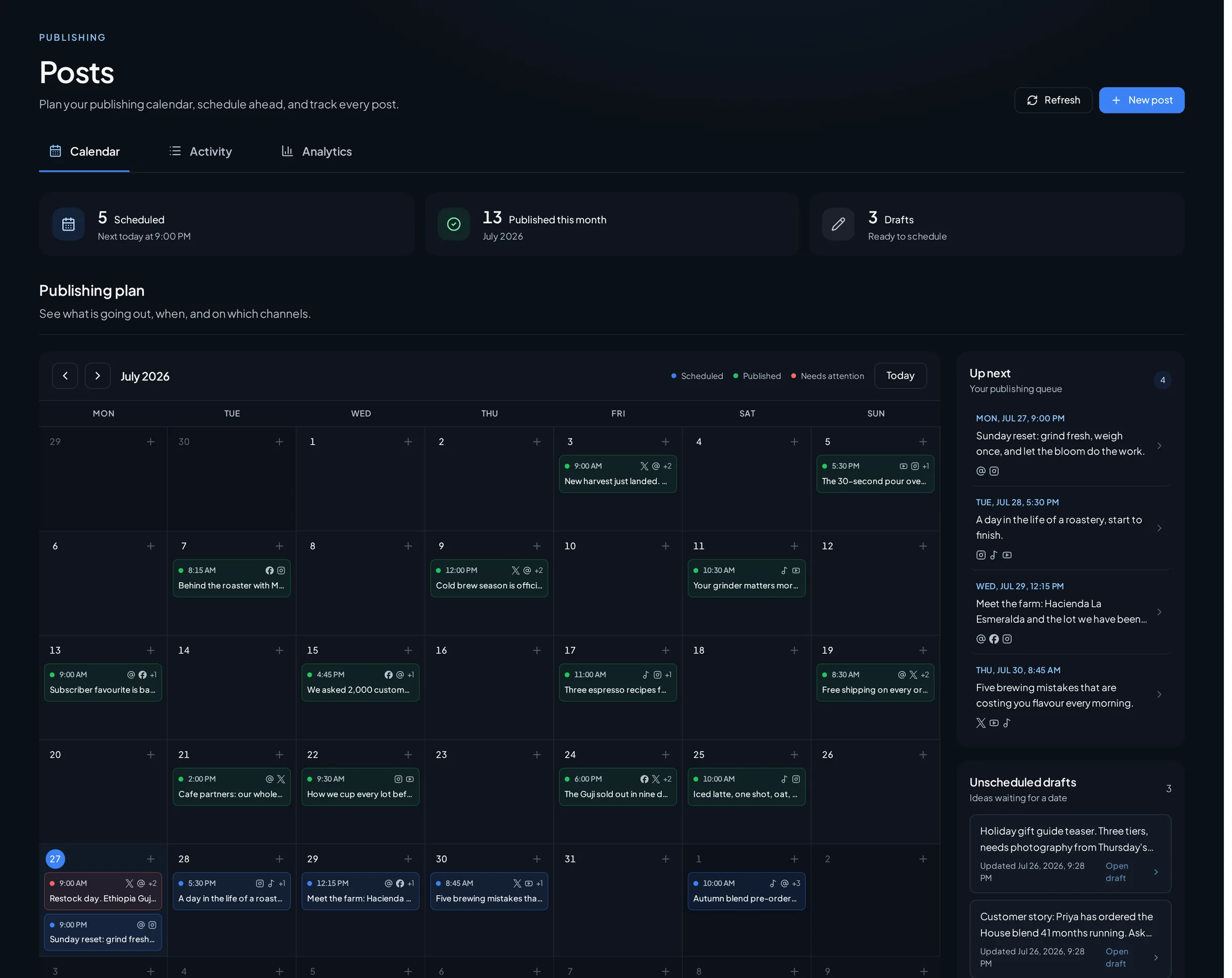
- Map the fixed dates first — announcement, opening, midpoint reminder, final hours, close — and treat those as immovable slots.
- Produce the creative against saved templates so eighteen posts do not become eighteen separate design tasks.
- Write each post against its destination’s constraints and check the platform validations before scheduling rather than during the week.
- Queue the full set with explicit destination review, since a peak-week post sent to the wrong account is far more expensive than a normal one.
- Leave one unscheduled slot per day for stock changes, sell-outs, extensions, and anything that needs a same-day response.
What the trading week actually needs
During the week the job changes from producing to monitoring. Because every destination reports its own publish status, a failure on one channel is visible without checking the others, and it can be fixed while the successful destinations are left alone.
Comment volume is the other predictable spike. Questions about delivery cut-offs, sizing, and stock arrive faster than usual, and they have direct revenue consequences during a peak window — which is why the reserved daily capacity matters more than one more scheduled post.
The most common failure in a well-planned peak week is a scheduled post that contradicts reality: promoting a sold-out product, or running a reminder for an offer that was extended. A scheduled campaign still needs one person checking that the queue matches the current situation.
The modeled operational outcome
Eighteen predictable posts are queued before the week opens, and the team spends peak days on exceptions, comments, and stock reality. The gain is capacity where it matters; sales still depend on the offer and the market.
The peak-week guardrail
Review the queue daily against stock and offer changes. A scheduled post promoting a sold-out item is worse than no post at all, and scheduling three weeks early makes that failure more likely rather than less.
Frequently asked questions
How far ahead should a seasonal campaign be scheduled?
Two to three weeks is usually enough for the fixed-date posts. Earlier than that and the risk of the content drifting out of step with stock or pricing grows faster than the benefit.
Should every post be scheduled in advance?
No. Schedule everything tied to a known date and deliberately leave daily capacity for sell-outs, extensions, and customer questions that cannot be predicted.
What happens if one channel fails during peak week?
Each destination carries its own status, so the failure is visible on that channel alone and can be retried or replaced without touching posts that published correctly.
How should the queue be maintained during the week?
One person should check the upcoming posts against current stock and offer status each day. Scheduling removes the writing work, not the responsibility for accuracy.