
About this case study
This models a research and distribution loop. It does not promise pipeline, and community participation carries real reputational risk when it is done as volume outreach.
Community work and content work rarely share evidence
A two-person B2B team monitors a handful of subreddits for buying-intent conversations and separately maintains a social calendar. The two efforts run on different weeks, use different language, and learn nothing from each other.
Meanwhile the community threads contain the most valuable raw material the team has: the exact wording of the problem, the workaround people settled for, and the objection that stops them switching. That language is better than anything produced in a positioning workshop.
The loop worth building is narrow. Monitored conversations produce a small number of genuinely useful replies, and the recurring themes across those conversations decide what gets published publicly.
The weekly loop
One pass per week keeps both halves connected:
- Review the week’s surfaced conversations and discard anything where the honest answer is that the product does not fit.
- Reply to the few threads where the team has genuine expertise, disclosing the affiliation and answering the question whether or not the product is mentioned.
- Log the repeated phrasing — the problem description, the workaround, the objection — as the input for public content rather than as a metric.
- Turn the most common theme into one or two posts for the channels the team already publishes to, adapted per destination instead of cross-posted.
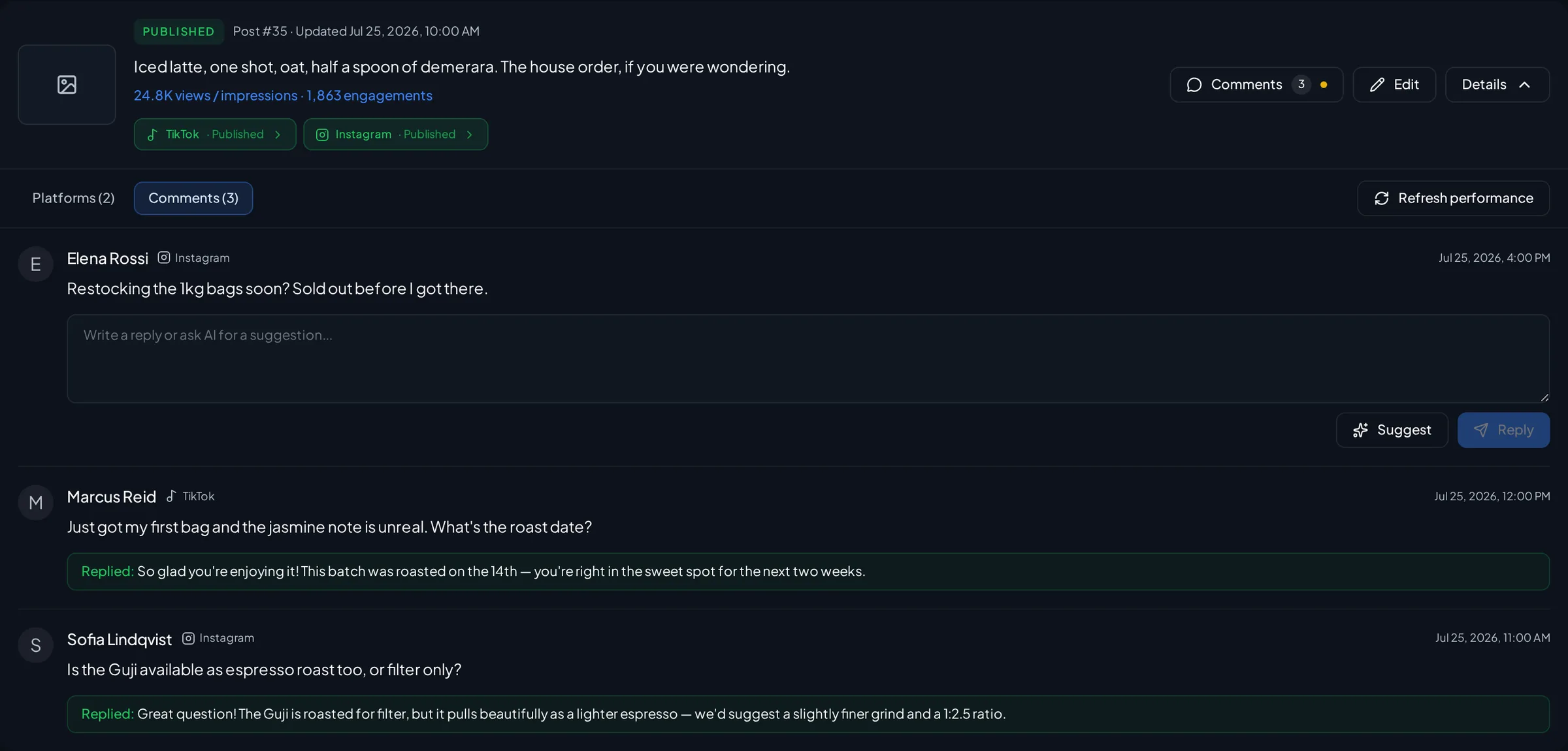
- Review reply outcomes and post performance together, so the same evidence informs both next week’s threads and next week’s calendar.
The credibility maths for B2B
Community replies scale badly on purpose. Five well-judged replies from someone who understands the problem are worth more than fifty templated ones, and fifty templated ones can cost the brand the subreddit permanently.
B2B makes this sharper than consumer marketing, because the buying audience for a niche tool is small and the same people appear repeatedly. A reply that reads as extraction is remembered by exactly the audience the team needs.
The public content side benefits from the same restraint. Community evidence should inform what the team writes about; it should not be republished as testimony, and individual posts should not be quoted as endorsements.
The modeled operational outcome
Monitored conversations, five reviewed replies, and two public posts run off one body of evidence in a single weekly pass. The output is a content calendar grounded in real language — not a predictable number of qualified opportunities.
The participation guardrail
Respect each community’s rules on self-promotion, disclose the affiliation, and skip threads where the product genuinely is not the answer. Volume outreach in communities is the fastest way to convert a useful channel into a permanent ban.
Frequently asked questions
How many community replies per week is reasonable?
For most lean teams, a handful. The constraint is how many threads someone with real domain knowledge can answer well, not how many the monitoring surfaces.
Should a reply always mention the product?
No. Answer the question first and mention the product only where it is genuinely relevant and the community allows it. Replies that exist only to place a link are recognised immediately.
Can community threads be quoted in public content?
Use them to understand language and priorities, not as attributed proof. Do not present public comments as endorsements or expose details that identify individuals.
How is a loop like this measured?
Track reply quality and follow-up conversations on the community side and normal channel metrics on the content side. Attribution between the two is usually indirect, and claiming otherwise tends to be a modelling artefact.