
About this case study
This guide describes a repeatable process for choosing and sequencing channels, not a reported customer result.
Judge the channels by time-to-signal, not by size
You built the app in a few days with Lovable, Bolt, Cursor, v0 or Replit, and now the hard part has arrived. The question almost everyone asks first is “ASO, SEO, or social?” — and almost every answer online is written by someone who sells one of the three. The comparison that actually helps is not which channel is biggest. It is how quickly each one tells you something you can act on.
Social media returns a signal in days. You post, and within a week you know which sentence made someone reply, which screenshot made someone ask a question, and which framing got silence. ASO returns a signal in weeks: store listings need indexing time, updates go through review, and the ranking inputs are partly out of your hands. SEO returns a signal in months, because a new domain has to be crawled, indexed, and then slowly trusted before impressions turn into clicks.
That difference decides your month one. A month is not long enough to win any of the three, but it is long enough to learn who your app is for — and only one channel can teach you that inside thirty days. The other two are not competing for the month. They are foundations you lay in the month so they can pay from month three onward.
The three channels, and the trade-off each one asks you to accept
Read this as the comparison table, with the cost of each channel stated honestly rather than hidden:
- Social media — signal in days, and the only one of the three that answers back with words you can reuse. The trade-off: it does not compound. Stop posting for two weeks and the channel goes quiet, because nothing you published keeps working while you sleep.
- ASO — signal in weeks, and it reaches people who are already inside a store searching for something like your app, which is the highest intent you will find anywhere. The trade-off: it only exists if you have a store listing, and the inputs that move rankings — installs, retention, ratings — come from traffic you have to earn somewhere else first.
- SEO — signal in months, and it is the only one that compounds. A page that ranks keeps delivering visitors without you touching it again. The trade-off: the longest feedback loop of the three, so a wrong guess about who you are writing for stays wrong for a full quarter before the data tells you.
Which channel fits which kind of app
If your app is listed in the App Store or Google Play, ASO is not optional. The store is a search engine, and your listing is the organic landing page you never get to redesign per visitor. Your title and subtitle carry the query, your first two screenshots carry the promise, and the description carries everything a hesitant person needs afterwards. But treat ASO as a multiplier on traffic rather than a source of it in month one: an empty listing with no installs and no ratings has very little to rank on.
If your app is a web app with no store listing, ASO simply does not apply, and the choice collapses into two channels. Social carries month one and SEO carries month four. The pages worth writing early are the boring high-intent ones: what your app does for one specific job, how it compares to the tool people currently use, and the workaround your users are typing into a search box today.
If you are building a developer tool, your audience is unusually searchable and unusually social at the same time. X and Threads carry more weight than they do for a consumer app, because the people who would use your tool already discuss tooling in public. Your SEO is not blog posts either — it is your docs, your error messages, and the how-do-I pages that answer a question someone hits at 2am. The store is not in the picture at all.
A sequence for month one
You are not picking one channel and abandoning the others. You are choosing what runs now and what you set up now so it can pay later:
- Week 1 — write the positioning once, in plain words: who it is for, what it replaces, what changes after they use it. Your store listing, your title tags and your posts are all compressions of that one paragraph, and writing it three separate times is how they end up contradicting each other.
- Week 1 — start posting. Three to five posts a week on the networks your audience already reads. This is the only channel that will return usable feedback before the month ends, so it goes first, not last.
- Week 2 — lay the ASO foundation if you have a store listing. Put the query people actually type into the title and subtitle, rebuild the first two screenshots around the promise, then leave the listing alone for two weeks. Editing it weekly destroys your ability to attribute any change.
- Week 2 — lay the SEO foundation. Confirm the site is indexable, give each page a title that matches a real query, link the pages to each other, and connect Search Console so the impressions have somewhere to show up.
- Week 3 — publish the two or three pages you can write honestly and well. Two good pages beat twenty thin ones, and thin pages are the thing that takes longest to undo.
- Week 4 — read what came back. Social gives you real numbers and real replies. ASO gives you an early impressions-to-installs read. SEO gives you indexation and almost nothing else, which is the expected result and not a failure.
What a realistic end of month one looks like
By day thirty you have four weeks of reviewed posts published, a short list of angles you know outperformed the others, a store listing whose words came from things real people said back to you, and two or three indexed pages that have not ranked yet. That is a working distribution system, not traction. ASO and SEO are still loading, and the point of month one is that they are loading with the right words in them.
The mistake that costs you the quarter
Do not judge SEO and ASO on month-one numbers and kill them. Both were always going to look dead at day thirty, and founders who restart the decision every month never accumulate anything on either. The other half of the mistake is running all three channels at full effort at once: with one person, that reliably produces three half-built channels instead of one working one and two loaded ones.
Go deeper
Once you have picked the sequence, these cover each track in detail:
- How to Distribute an App: The Complete Guide for Founders Who Have Built SomethingThe full distribution picture this decision sits inside, from first users to a repeatable weekly loop.
- How to Improve SEO for Your App Without GuessingHow to improve SEO for a small app without guessing which pages are worth writing.
- How to Promote Your App on Social MediaWhat the social track looks like week to week once it is running.
- Why Nobody Is Using Your App (and the Distribution Gap Behind It)Why a good app can launch to silence, and what the gap usually turns out to be.
- Turn Your Landing Page Into 30 Days of Social PostsTurn the positioning page you wrote in week one into a month of posts.
- Generate a planned week of postsSee how the weekly plan is built, with a role and a date on every post before you review it.
- Start your workspacePoint Amplispect at your app site and get the first planned week to edit.
Frequently asked questions
What is the difference between ASO and SEO?
ASO optimizes your listing inside an app store, where ranking depends on your title, subtitle, screenshots and description plus behavioural inputs like installs, retention and ratings. SEO optimizes pages on the open web, where ranking depends on content, links and site health. ASO only applies if you have a store listing; SEO applies to every app with a website.
Where should I market a new app first?
Start with social media, because it is the only channel that returns feedback inside your first month. Use the same month to lay the ASO and SEO foundations so they can start producing from month three. Choosing one channel and ignoring the others usually costs you a quarter.
How long does it take for ASO and SEO to work?
Expect an early ASO read in weeks — impressions and install conversion move once a listing has been indexed and has some traffic behind it. Expect SEO to take months: a new domain has to be crawled, indexed and trusted before impressions turn into meaningful clicks. Neither is a fair judgement at day thirty.
Can I skip social media and rely on SEO?
You can, but you give up your fastest source of learning. Social is where you find out which sentence describes your app in words other people repeat, and those words are exactly what your store listing and your landing pages need. Skipping it means writing your SEO pages on guesses for a quarter.
Running the social track without letting it eat the month
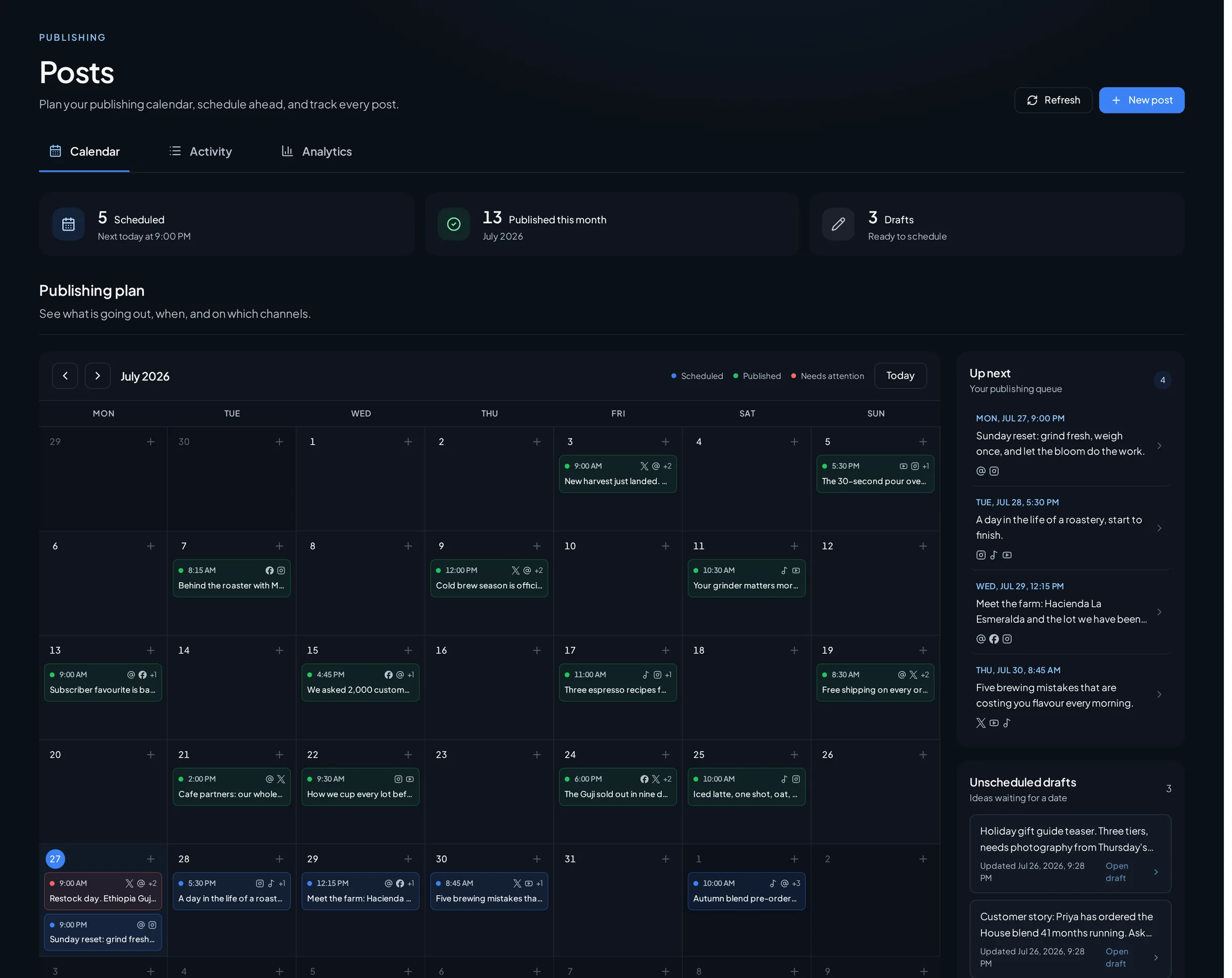
The reason founders drop social in week two is not that it fails. It is that a blank composer every Monday morning is an unpriced tax on the week. Amplispect removes that by building the workspace from your site: point it at your app, and it reads the offer, the audience and the brand voice into a workspace, so you are never re-explaining your product to an empty box.
From there it generates a planned week of posts on a cadence you set — each post with a role and a date, for Instagram, Threads and X. You open the composer, see a per-network preview and validation before anything is queued, edit whatever sounds wrong, and schedule the week. Nothing publishes without your review, and each destination keeps its own publish status so a failure on one network stays one network.
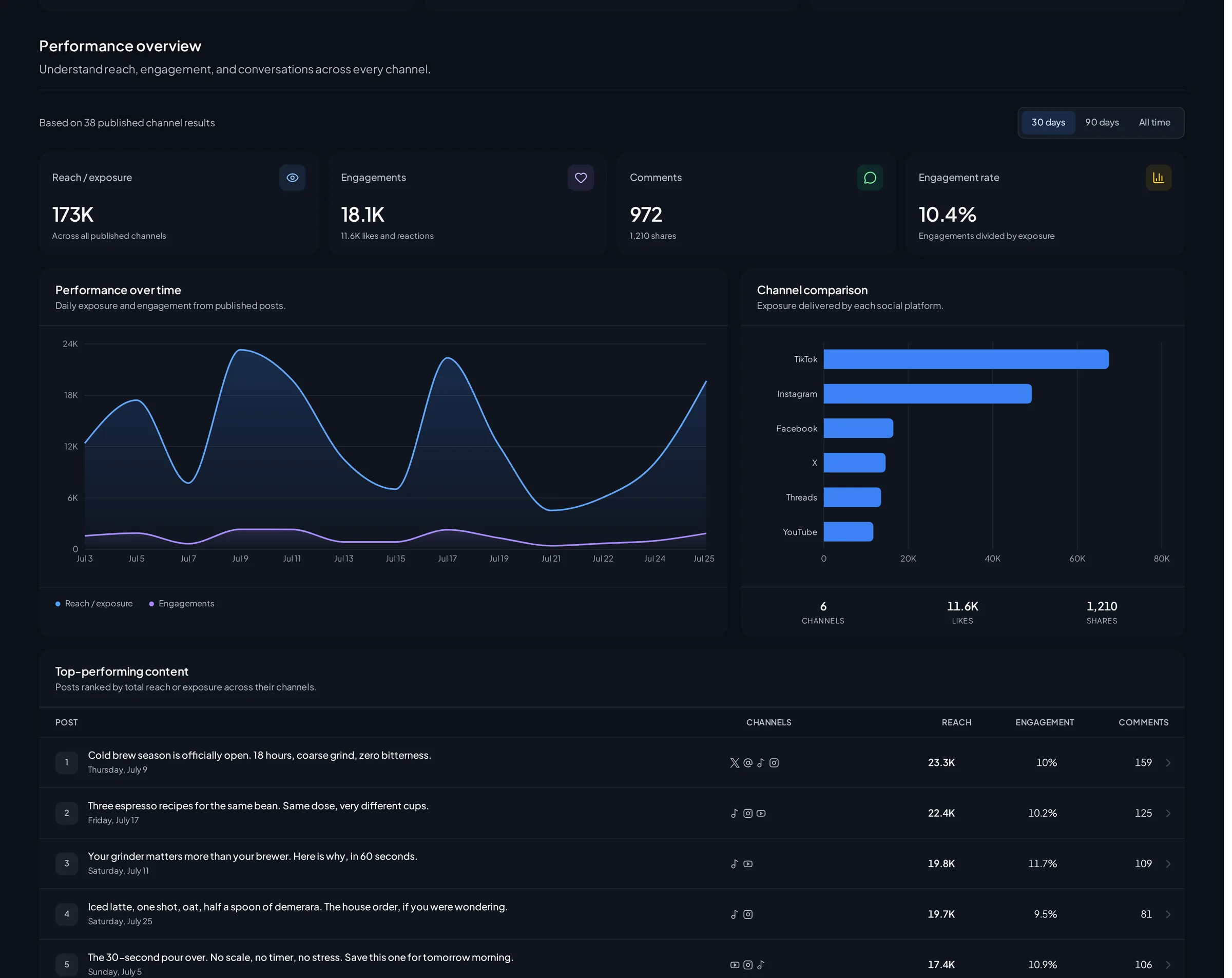
Then you read the performance view: which posts earned replies, which format held attention, which angle went nowhere. That reading feeds the next generated week, so week three is not a fresh guess but an edit of week two. Thirty focused minutes on a Monday is enough to keep the fast channel running while the slow channels quietly index.