
About this case study
This article describes a repeatable diagnostic and posting process, not a reported customer result or a promise of downloads.
The gap between “built” and “used”
In 2026 you can go from idea to a working app in a weekend. Lovable, Bolt, Cursor, v0 and Replit removed most of the reasons a product used to die before it shipped. What they did not remove is the part that comes after: the slow, unglamorous work of putting the app in front of the same people, repeatedly, until enough of them care.
So the question “why is nobody using my app?” almost never has a product answer. The app works. The gap is between your app and the people who would use it, and nothing crossed it. Either nobody heard about it, or the people who did hear about it failed to recognize their own problem in the way you described it.
What follows are the seven causes that show up most often when a launched app has no users, each with the fix. Read them as a diagnostic rather than a to-do list. Most founders have three or four of them, not all seven.
Seven reasons nobody is using your app
Go through these honestly and mark the ones that describe your last month:
- You launched once instead of continuously. Launch day is a single impression delivered to a small fraction of an audience that was not paying attention. The fix: treat the launch as the first of roughly fifty posts, not as the event that decides whether the app lives.
- Your landing page describes features, not the problem. Visitors do not scan for “AI-powered” or “built with the latest stack”; they scan for the sentence that names the thing they are stuck on. The fix: put the problem in the first line, in the words your users already use, and move the feature list below it.
- You are posting where you are, not where your users are. Most founders post on the network they personally read, which is rarely the room where their users ask for help. The fix: write down the three places your target user actually goes when the problem bites, and show up there even if the format is uncomfortable.
- You have no cadence, so nothing compounds. Five posts in one enthusiastic evening followed by a month of silence reads, to a person and to a ranking system, as an abandoned project. The fix: choose a number of posts per week you could still hit during a bad week, and hold that number instead of the ambitious one.
- You have no feedback loop from what got replies. If you cannot name which of your last twenty posts started a conversation, every new post is a fresh guess. The fix: review the week that just happened before you plan the next one, and let the posts that earned replies decide what you make more of.
- You count the wrong things. Followers and impressions move up and down without anything changing in your business, so they make a flat month feel productive and a good month feel flat. The fix: count replies, profile clicks, visits from social and sign-ups, and treat follower count as trivia.
- You gave up in week two. This is the most common reason of all. Distribution has a delay built into it: the attention you accumulate in weeks one through six is what makes week eight produce anything. The fix: commit to twelve weeks before you judge a channel, and judge the cadence you kept, not the outcome you hoped for.
The two reasons that are operational, not motivational
Reasons one, two, three and seven are decisions. You can act on them this afternoon by rewriting a headline, choosing different rooms and deciding not to quit. Reasons four and five are different in kind. Cadence and feedback do not fail because you disagree with them; they fail because maintaining them by hand costs more attention than you have left over after building the product.
That is the narrow gap a workspace is supposed to close. Amplispect builds one from your website, so it starts from your real offer, audience and brand voice rather than an empty calendar. From there it plans a week of posts on a cadence you set, each with a role and a date, for Instagram, Threads and X.
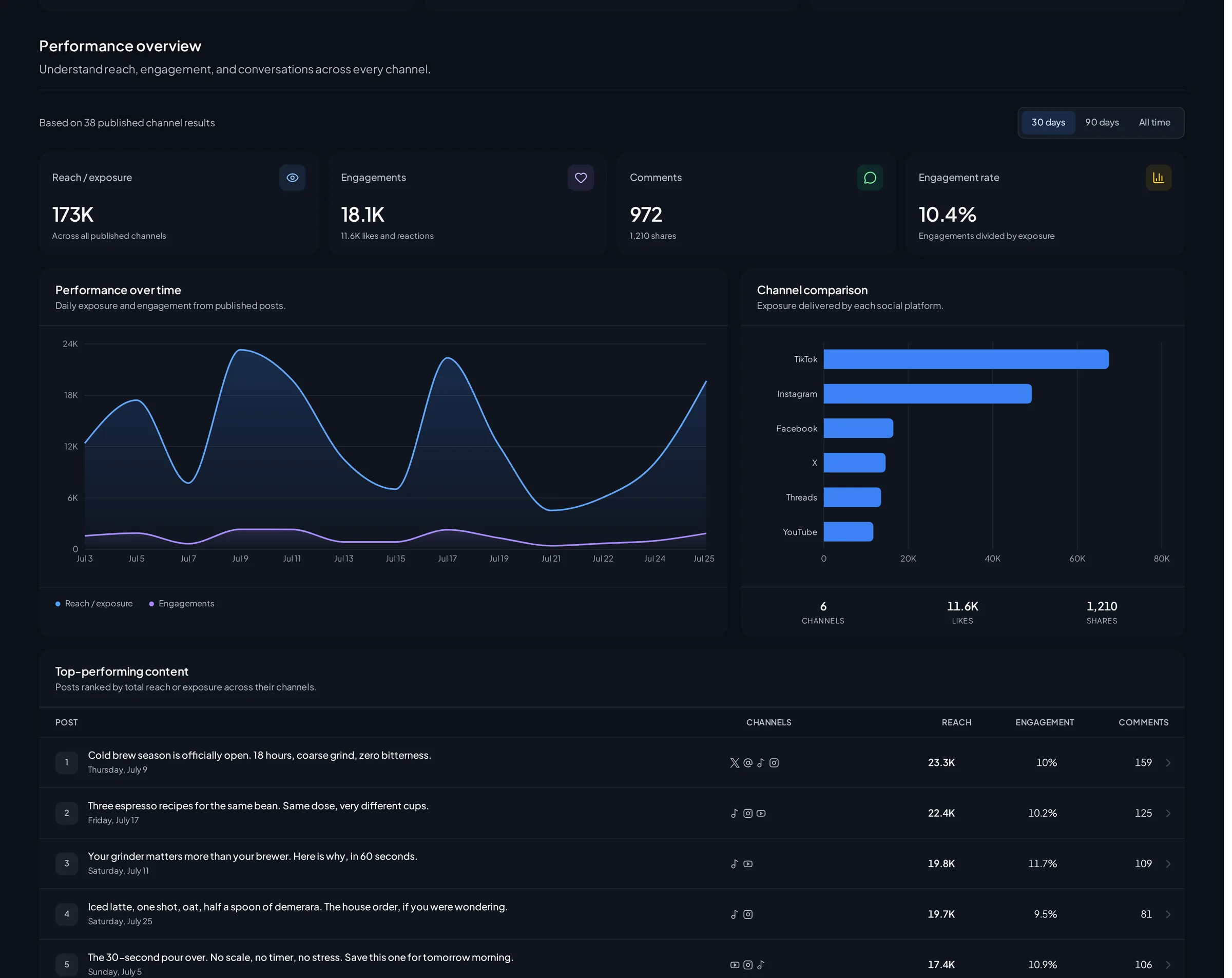
Nothing publishes without you. Each planned post arrives as a draft you review, edit or delete in a composer that previews how it will look on every destination and flags anything a network will reject. When the week has run, the performance view shows what actually happened, and that result feeds the next generated week. After about a month, the plan stops being a guess and starts being a response to evidence.
What to count instead of followers
Replace the vanity dashboard with six numbers that change how you act next week:
- Replies and direct messages traceable to a specific post, rather than the total follower number.
- Profile clicks, because they mark the moment someone moved from reading you to investigating you.
- Visits to the app site from social, split by network, so you learn which room repays the effort.
- Sign-ups per week, even when the number is two. Early on, the direction matters far more than the level.
- Weeks completed as planned. This is the leading indicator behind everything above and the only one entirely under your control.
- One written sentence per week naming the post that did best and your best guess as to why.
The twelve-week rule
Almost everyone who concludes that distribution does not work for them stopped somewhere between day nine and day twenty. The decision feels rational at the time: you posted for two weeks, nothing measurable happened, and shipping the next feature was obviously a better use of the evening. But two weeks of posting is not a test of a channel. It is a test of whether you can survive a channel warming up.
A commitment that survives contact with reality is twelve weeks at a cadence you would still keep during a busy week. Three posts a week is a real answer, and a better one than seven posts a week you abandon by week three. Twelve weeks gives you roughly thirty-six posts, which is enough to see a pattern in what earns replies and enough for the same person to encounter you more than once.
At the end of it you have something you do not have today: evidence. Either the channel produced conversations and you concentrate there, or it did not and you move the same cadence somewhere else. Both outcomes are progress. Quitting in week two produces neither, and it leaves the original question unanswered.
What this looks like when it works
After a quarter you have three things you lack now: a plan that covers next week before Monday, a posting habit that survives a bad week, and a shortlist of posts you know started conversations. That is a distribution practice. It is not a promise of downloads or revenue, which still depend on the product, the offer and the price, but it replaces “nobody is using my app” with a question you can actually answer.
The guardrail
A cadence does not rescue a product nobody wants. If twelve honest weeks in the right rooms produce interest but no retention, the answer is in the product, not in more posts. And do not automate past the review step: publish nothing you have not read, and never paste the same message into communities that have asked you not to.
Go deeper
If one of the seven reasons above described your last month, start here:
- How to Distribute an App: The Complete Guide for Founders Who Have Built SomethingThe full distribution playbook this diagnostic measures against, from positioning through to a weekly cadence.
- I Built an App With Lovable, Bolt or Cursor. How Do I Get Users?What to do in the first month after shipping an app built with Lovable, Bolt or Cursor.
- How to Find the Target Audience for Your AppHow to work out who the app is actually for, which is what fixes reasons two and three.
- How to Grow Your App With a Weekly Acquisition LoopThe weekly loop that turns posting into something that compounds instead of resetting.
- How Much Time Should a Solo Founder Spend on Marketing vs Building?How to split the week between building the product and telling people it exists.
- Weekly content calendar generatorSee how a week of planned posts is generated on a cadence you set, then reviewed before anything publishes.
- Start a workspacePoint Amplispect at your app website and see the first planned week for Instagram, Threads and X.
Frequently asked questions
Why is nobody using my app?
In most cases the app is fine and the distribution never happened. A launch reaches very few people, a feature-led landing page fails to name the problem, posting happens in the wrong rooms without a cadence, and the founder stops before the channel warms up. Work through the seven reasons above and you will usually find three or four of them apply.
I launched my app and got no downloads. What should I do first?
Rewrite the first line of the landing page so it names the problem in the words your users use, then pick one channel where those users already talk about that problem and commit to a fixed number of posts per week. Changing the message and the room costs one afternoon and usually explains more than any product change would.
How long should I promote my app before deciding it does not work?
Twelve weeks at a cadence you can sustain, which is around thirty-six posts. Two weeks measures nothing except your patience. If twelve weeks in the right rooms produce conversations but no retention, the problem has moved to the product, and that is a useful answer too.
Do I need a big following to get users for my app?
No. Early users come from specific conversations, not from audience size. A post that reaches two hundred of the right people and earns four replies is more useful than one that reaches twenty thousand of the wrong ones. Count replies, profile clicks and sign-ups rather than followers.