
About this case study
This guide describes a repeatable launch-week process, not a reported customer result or a promise about downloads.
One message, four native formats
You built the app in a few weekends with Lovable, Bolt, Cursor or Replit, and now launch week is on the calendar. The instinct is to write four separate launches, one per platform, and then run out of energy by Wednesday. The plan that survives contact with a real week is the opposite: decide one message, then translate it into four native formats.
One message means one sentence you can say out loud: who the app is for, what it replaces, and what changes after five minutes of use. Everything you post that week is a different camera angle on that sentence. If the X thread, the LinkedIn post, the Reddit comment and the TikTok demo each make a different promise, nobody remembers any of them.
It also helps to be clear about which half of the week a tool can carry and which half you carry yourself. Amplispect plans, schedules and tracks the Instagram, Threads and X posts: you write the message once in the composer, check the per-network preview, queue it, and watch the per-destination publish status on launch morning. LinkedIn, Reddit and TikTok are not publishing destinations in Amplispect. You post those three by hand, on their own terms, and that is the right trade, because those are exactly the rooms where a hand-written post beats a syndicated one.
So the week splits cleanly. The scheduled half is decided before Monday and runs without you. The manual half is three deliberate posts, each written for the room it is going into. And the part nobody can schedule, replying to everyone who responds, is where the launch actually happens.
What to prepare before Monday
Launch week goes badly when you are still writing copy on Tuesday morning. Every item below should already exist as a file or a draft before Monday starts:
- One sentence naming who the app is for and what it replaces. Write it, read it out loud, then cut it in half.
- A 30 to 45 second screen recording of the app doing its single most useful thing. No intro, no logo animation.
- Three to five screenshots at real resolution, cropped so the interesting part is not a grey sidebar.
- The X thread drafted end to end: a hook post, three or four posts of substance, one post with the link.
- The LinkedIn post drafted as a story about why you built it, not as a press release about what it does.
- A shortlist of subreddits whose rules you have actually read, with a note on each about whether self-promotion is allowed at all.
- Working links: landing page, app store listing or web app, and a support address that reaches a human.
- Two hours blocked on launch day for replies, with nothing else in that block.
The week, day by day
Monday is setup, not launch. Load the week into the composer: an Instagram post carrying the screenshots, a Threads post carrying the short version of your one sentence, and the X thread built for Thursday morning. Preview each one per network, fix the caption that reads fine on Threads and badly on X, and schedule them. Monday should end with the scheduled half of your week already in the queue.
Tuesday is the build-up. Post the behind-the-scenes version on Instagram and Threads: what almost broke, the bug you shipped anyway, the feature you cut. This is not filler. It gives the people who already follow you a reason to be watching on Thursday, and it gives you something concrete to point at when someone asks what you have been doing all month.
Wednesday is the TikTok day, and it has to be done by hand. Record the screen demo, add burned-in captions, keep it under 45 seconds, and post it yourself from the phone. Do not narrate the roadmap. Show the thing working, once, with the problem stated in the first two seconds.
Thursday is launch. The X thread publishes from the queue in the morning while you are still making coffee. You post the LinkedIn story by hand around the same time, in your own words, with one screenshot and no link in the first paragraph. Then you sit in the replies, and that is the job for the rest of the day.
Friday is Reddit, and only if you have earned it. Find the thread where someone is describing the problem your app solves and answer the question properly, in a way that stands on its own. If the subreddit allows a link and the link genuinely completes the answer, add it at the end. If it does not, leave it out and answer anyway.
The weekend is a recap post on Instagram, Threads and X: what you shipped, what people asked for most, what you are doing next week. Schedule it on Friday afternoon so you do not have to think about it, and use it as a natural way to reply to everyone who arrived late.
What each channel is actually asking for
The manual channels punish copy-paste hardest. Here is what each one wants from a launch:
- X: a thread, not a link drop. The first post has to work with no context and no link. The link belongs in the last post or the first reply.
- LinkedIn: a story post. Start at the moment you decided to build it, keep paragraphs to one line, and end with a question people can answer without visiting anything.
- Reddit: a contribution, not a launch. Only in subreddits whose rules allow it, only in threads where your answer is useful without the link, and never the same text twice.
- TikTok: a screen recording, not a trailer. Problem in the first two seconds, the app solving it in the next twenty, captions burned in because most people watch with the sound off.
- Instagram and Threads: the same message at different lengths. Threads takes the conversational one-liner, Instagram takes the carousel of screenshots with the longer caption.
- Every channel: one call to action per post, and the same landing page behind all of them so the week reads as one number instead of six.
Replying to comments is the real launch work
Everything up to Thursday morning is preparation. The launch itself is a two-day conversation. A reply in the first hour is worth more than the post it is attached to: it is what tells the platform the post is worth showing to more people, and it is what tells a stranger there is a person behind the app.
Answer every comment, and not with a thumbs up. If someone asks whether it does X, say yes and how, or say no and whether it is planned. If someone reports a bug, say when you will fix it, fix it, then reply again in the same thread. That second reply is the one people screenshot and quote.
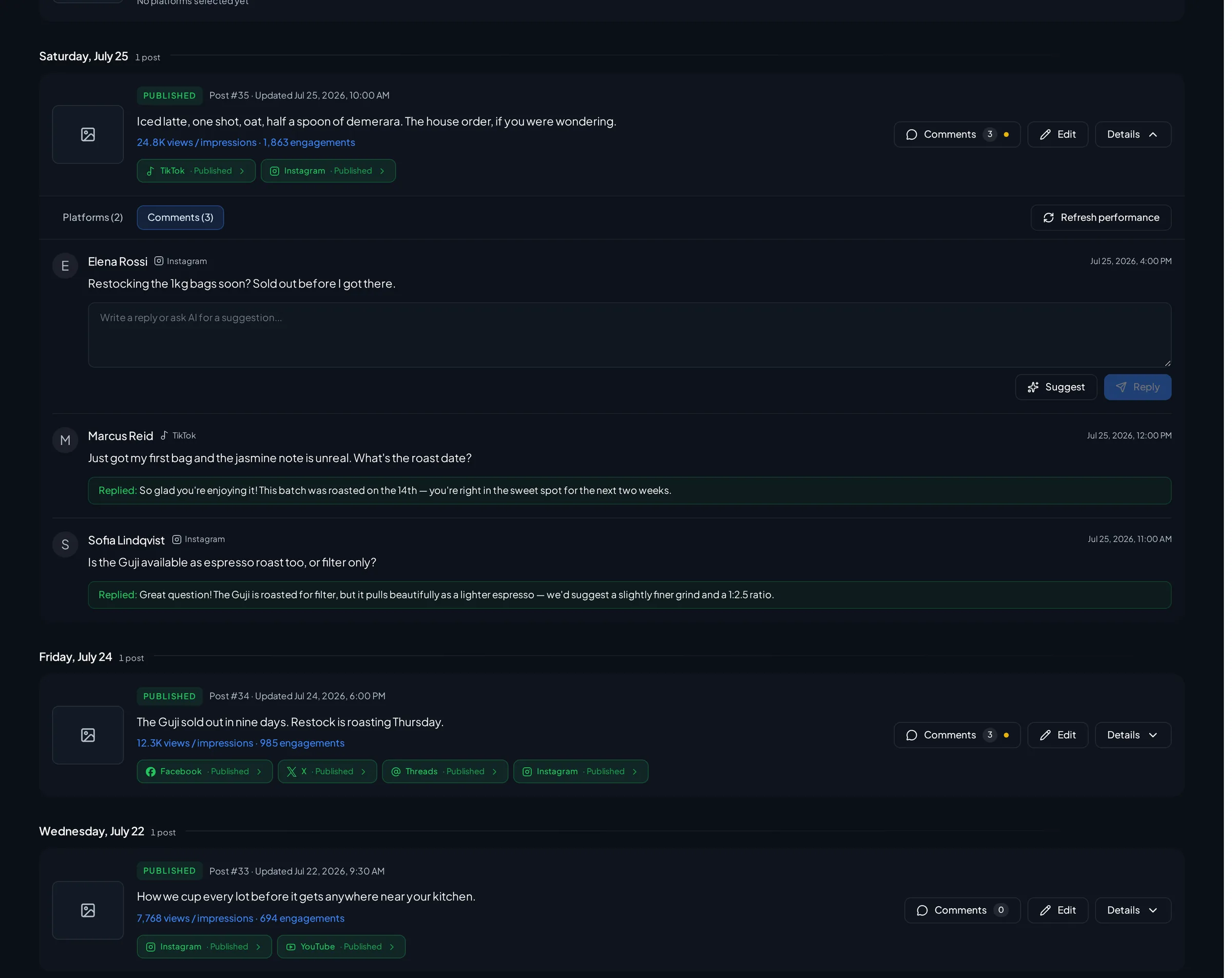
Comments from Instagram, Threads and X sync into Amplispect, so you can work through them in one list instead of four tabs, with a reply draft already waiting. Nothing sends until you have read and approved it. LinkedIn, Reddit and TikTok comments you handle in their own apps, which is another argument for keeping those three to one post each: three comment sections is a workload one founder can carry, six is not.
What a good launch week actually produces
A realistic outcome: three scheduled posts that went out on time without you touching them, three hand-written posts in the rooms where hand-written wins, one list of every comment you answered, and a short list of the three things people asked for most. That last list is your next month of building. Downloads are a result you measure afterwards, not something the week can promise.
The guardrail
The fastest way to waste launch week is to paste the same paragraph into four places on the same morning. Reddit in particular will remove it, and a removal follows the account in a way a flat LinkedIn post does not. Read each subreddit’s rules before you post, treat a link as something you earn inside a useful answer, and if you cannot make the comment useful without the link, do not post it at all.
Go deeper
The rest of the launch cluster, plus the two product pages behind the tooling described here:
- Product Hunt Launch Checklist for Indie Apps (2026)The checklist for the one launch day that runs on its own clock and its own rules.
- App Launch Content Calendar Template: 3 Weeks, Day by DayA filled-in calendar to start from if you would rather edit a week than invent one.
- How to Market Your App on Reddit Without SpammingHow to be genuinely useful in a subreddit without getting the post removed.
- How to Promote Your App on Social MediaWhat to keep posting once launch week is over and the spike has flattened.
- How to Distribute an App: The Complete Guide for Founders Who Have Built SomethingThe full picture of how an app finds users, with launch week as one chapter.
- Instagram, Threads and X schedulerOne composer, a preview per network, and a publish status for every destination.
- Comment managementSynced comments and reviewed reply drafts for the two days when replying is the job.
Frequently asked questions
Can you launch an app on X, LinkedIn, Reddit and TikTok in the same week?
Yes, if you write one message and adapt it to four native formats instead of writing four launches. Prepare the assets before Monday, schedule what can be scheduled, and spread the hand-posted channels across different days so you are never posting and replying in two places at once.
What should you post on each platform during a launch week?
A thread on X with the link at the end, a first-person story on LinkedIn, a useful answer on Reddit in a thread where the problem is already being discussed, and a short screen-recorded demo on TikTok. Instagram and Threads carry the screenshots and the build-up posts.
Can Amplispect post to LinkedIn, Reddit and TikTok?
No. Amplispect publishes to Instagram, Threads and X, with one composer, a per-network preview and a publish status for each destination. LinkedIn, Reddit and TikTok are posted manually, which is also what those communities respond to best.
How many posts should an app launch week have?
Around six to eight, not thirty. Roughly one build-up post, one demo, one launch thread, one story post, one community answer and one recap. Fewer posts with real replies underneath them outperform a wall of announcements nobody answers.