
About this case study
This guide describes a repeatable launch process, not a reported customer result, and no checklist can promise a particular ranking.
What a Product Hunt launch can and cannot do
In 2026 you can build a working app in a weekend with Lovable, Bolt, Cursor, v0 or Replit. Shipping stopped being the hard part. The hard part is the day you tell the internet that the app exists, and Product Hunt is still the place most indie founders choose to do that.
A launch is one day of concentrated attention. It will not build an audience for you, and it cannot rescue a product that nobody has tried yet. What it can do is compress the work you already did, the beta testers, the build-in-public posts, the people who replied to your screenshots, into a single visible moment, and hand you a page you can link to for years.
So treat the launch as the middle of a three-week process rather than as an event. Fourteen days of preparation, one day of presence, seven days of follow-up. Everything below is written in that order, and none of it depends on reaching a particular position on the day.
Fourteen days before: assets, hunter, warm list
Two weeks is enough time to prepare everything that cannot be improvised at six in the morning:
- Write the tagline first. One short line, plain language, saying what the app does and for whom. If a stranger cannot repeat it back to you, rewrite it.
- Write the description as though the reader has never heard of the category, then cut every adjective that carries no information.
- Build the gallery: a first image that still reads as a thumbnail, then three to five screens that walk through the real flow. A short demo helps only if the product is on screen within the first two seconds.
- Draft the first comment now. It is your maker introduction: why you built this, what it does not do yet, and one direct question that invites a reply.
- Decide between a hunter and a self-launch. Hunting your own product is normal and gives you full control of the timing and the copy. A hunter is only worth it when that person genuinely uses the product and will stay in the comments with you.
- Build a warm list of thirty to sixty people who will genuinely try the app: beta testers, people who replied to your build-in-public posts, users who emailed you a bug. This is not a contact dump.
- Write the message you will send that list, one person at a time, and stop at asking them to take a look. Do not script an upvote.
- Pick the date, lock it, and plan the fourteen days of posts that lead up to it.
The fourteen-day run-up, scheduled in advance
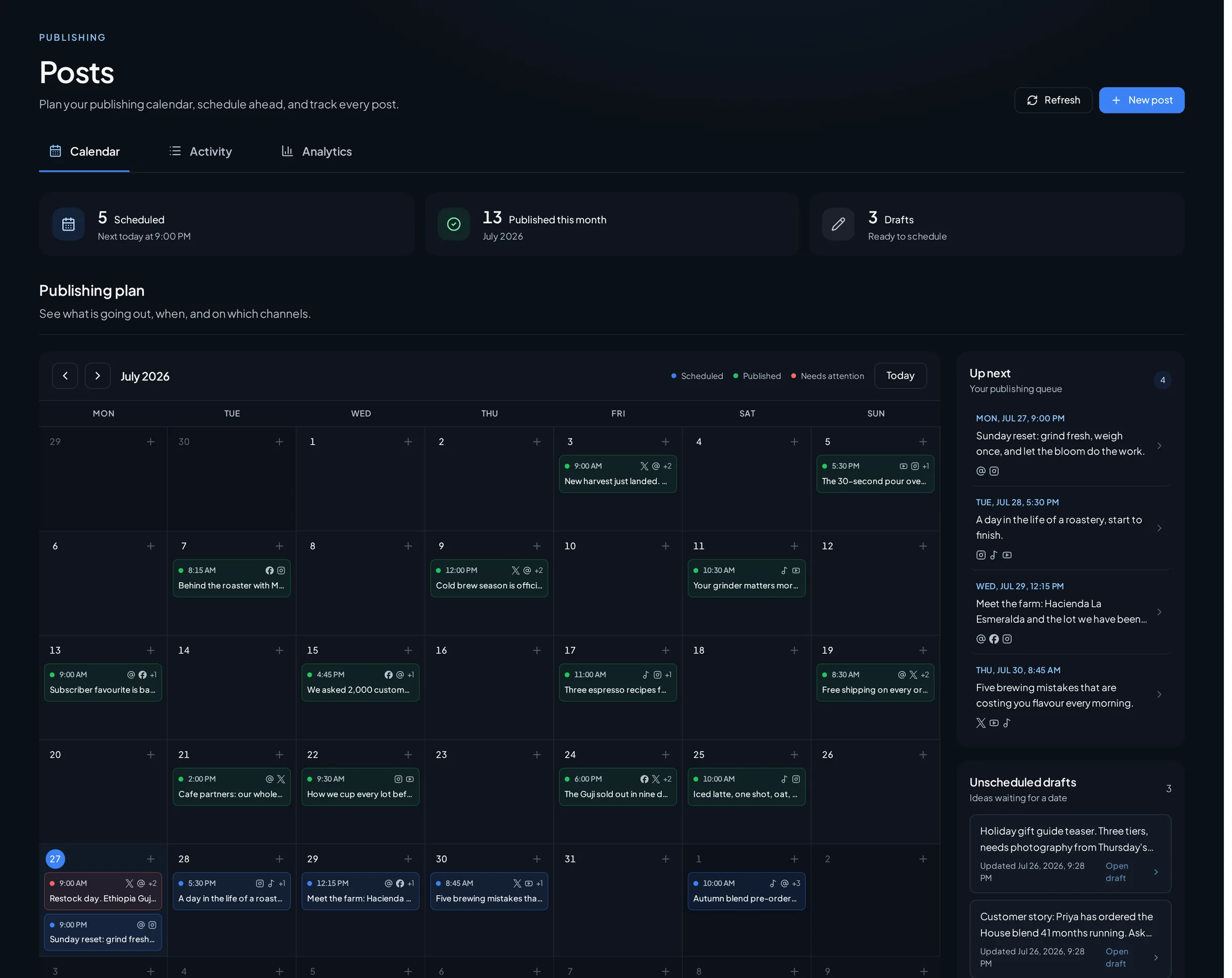
Most launches feel flat because the announcement is the first thing the audience has ever heard from the founder. A run-up fixes that. For the fourteen days before launch, post on Instagram, Threads and X on a cadence you can actually keep. One post a day is plenty. Three a week is fine if that is the honest number.
The run-up is not fourteen advertisements. The first week is the problem: what you kept running into, what the workaround cost you, who else complained about the same thing. The second week is the product: one screen a day, a decision you reversed, a feature you cut, the thing that broke in testing. The last three days name the date.
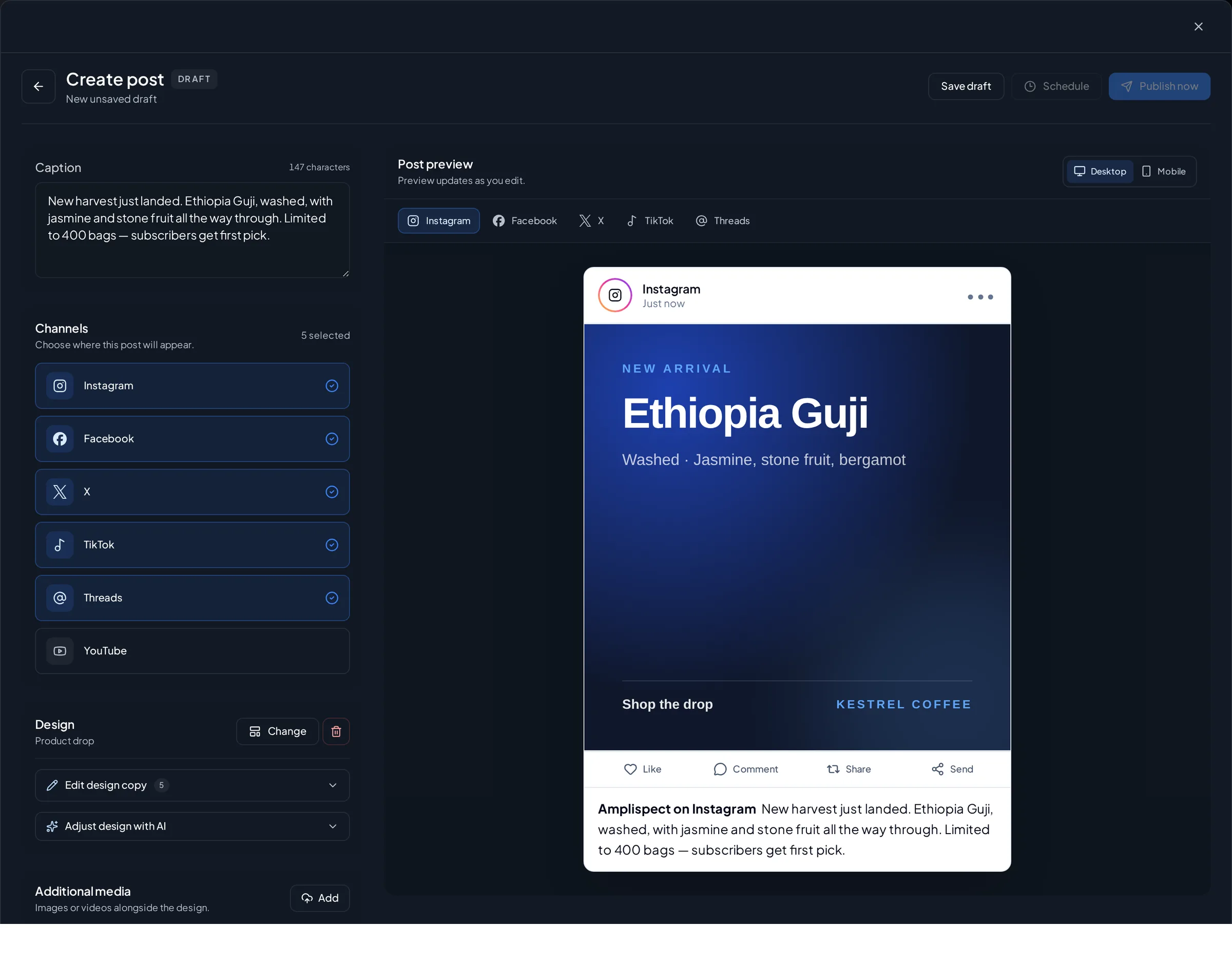
Plan and schedule the whole run-up in Amplispect before it starts. The workspace reads your site to learn the offer, the audience and your voice, generates a week of planned posts on a set cadence with a role and a date for each one, and the composer shows a per-network preview and validation before anything is queued. Nothing publishes without your review.
Scheduling ahead is not automation for its own sake. It is that on launch day the posts go out on their own, which leaves your hands free for the one thing that cannot be scheduled: answering the people who show up.
Launch day, hour by hour
Product Hunt days run on Pacific time and start just after midnight. Work the day in blocks instead of staring at the page:
- First hour: the listing goes live, and the first comment goes up immediately after it, so anyone who arrives has something to react to.
- First two hours: send the warm-list messages you already wrote, one at a time, in your own words, with the link. This is the only genuinely time-sensitive part of the day.
- Morning: your scheduled Instagram, Threads and X posts publish on their own. Check that each destination reported as published, then answer the replies they bring in.
- Midday: reply to every comment on the listing, including the critical ones. A thoughtful answer to a hard question is worth more than five thank-yous.
- Afternoon: post one update from inside the day, a screenshot, a question someone asked, a bug you fixed live. Launch-day content is better when it is reported rather than prepared.
- Evening: thank people by name where the thanks is genuine, and close out anything still open in the comments.
- All day: stop refreshing the ranking. It costs you the replies, and the replies are the part you keep.
What a well-run launch actually leaves you
By the end of the day you own a permanent product page with a real maker comment on it, a thread of questions that tells you exactly what people misunderstand, a list of names who showed up when you asked, and fourteen days of posts that introduced your app to an audience that had never heard of it. No checklist can promise a position on the leaderboard. Those four things are what the process is actually for.
The seven days after
Most founders go quiet the day after, which wastes the only week where people are already willing to look. Plan this week before launch day, not during it:
- Day one: a short thank-you post on each network with one honest number you are willing to share, plus the thing that surprised you.
- Day two or three: turn the most common question from the comments into its own post. It has already proved that people find it interesting.
- Mid-week: ship one small fix that came straight out of launch feedback, and say that is where it came from. Nothing builds trust faster than a visible response.
- Every morning: reply to the comments that arrived overnight, on the listing and on social. Late comments usually come from the people who read carefully.
- Once: email the warm list with what happened and what changed because of them.
- End of week: fold the launch back into your normal cadence and keep posting. The launch page keeps working on its own; the audience only keeps growing if you do.
The guardrail
Never ask anyone for an upvote, never coordinate voting in a group chat, and never message strangers who have no reason to care about your app. Ask people who already know the product to take a look and tell you what they think. Everything else puts the launch at risk and, more importantly, spends relationships you took months to build.
Go deeper
The rest of the launch cluster, plus the two product pages this checklist relies on:
- App Launch Content Calendar Template: 3 Weeks, Day by DayThe day-by-day content calendar that this checklist assumes you are already running.
- How to Launch an App on X, LinkedIn, Reddit and TikTok in the Same WeekHow to spread a single launch across several platforms inside one week without repeating yourself.
- How to Distribute an App: The Complete Guide for Founders Who Have Built SomethingThe wider distribution picture that a launch day sits inside.
- Your First 10 Posts About Your App When You Have No Users or TestimonialsWhat to write during the run-up when you have never posted about the app before.
- How to Get Beta Testers for Your AppHow to find the testers who later become the warm list you message on launch day.
- AI social media schedulerQueue the run-up and the launch-day posts for Instagram, Threads and X, with a preview and validation per network.
- Content calendar generatorGenerate a planned week of posts on a set cadence, each with a role and a date.
Frequently asked questions
How do I launch on Product Hunt?
Prepare the tagline, description, gallery and first comment about two weeks ahead, decide whether you hunt the product yourself or ask a hunter, build a warm list of people who will genuinely try it, run a fourteen-day social run-up, then spend launch day replying rather than posting.
Do I need a hunter to launch on Product Hunt?
No. Hunting your own product is normal and gives you full control of the date, the copy and the first comment. A hunter only adds something when that person actually uses the product and will stay in the comments alongside you.
How long before a Product Hunt launch should I start promoting?
Fourteen days is a workable run-up for a solo founder. It is long enough to introduce the problem, show the product and name the date without turning your feed into two weeks of advertising.
What should I post on launch day?
Schedule the announcement posts in advance so launch day itself is free, then add one unscheduled update from inside the day, such as a screenshot, a question someone asked, or a fix you shipped live. Reply to every comment on the listing and on social.