
About this case study
This describes a repeatable weekly process, not a reported customer result or a promise that posting will produce sign-ups.
Why marketing feels worse than code
Shipping is no longer the bottleneck. With Lovable, Bolt, Cursor, v0 or Replit, the app that used to take a quarter takes a weekend. Then the work changes shape: no compiler, no test suite, no stack trace, no obvious next commit. Just a URL nobody has seen and a vague instruction to “market it”.
The dislike is usually not about marketing in the abstract. It is about three specific things. Performing — writing in a voice that is not yours, on camera if possible. Remembering — posting every day forever, with the guilt that comes from missing a day. Guessing — never knowing whether any of it did anything, which is the part developers find genuinely unpleasant.
None of those three are marketing. They are a marketing process that has no system behind it. Give the same work defined inputs, a scheduled job, a review step and logs, and it stops feeling like performance. You are not being a creator. You are operating a small pipeline, which is a thing you already know how to do.
Define the inputs, the output, the job, and the logs
The input is your site. Your landing page already states the offer, names the audience and carries a tone. Amplispect reads a website URL and builds a workspace from it, so the voice becomes stored configuration instead of something you improvise at 11pm. When the product changes, you change the site copy and the input changes with it. That is the whole config file.
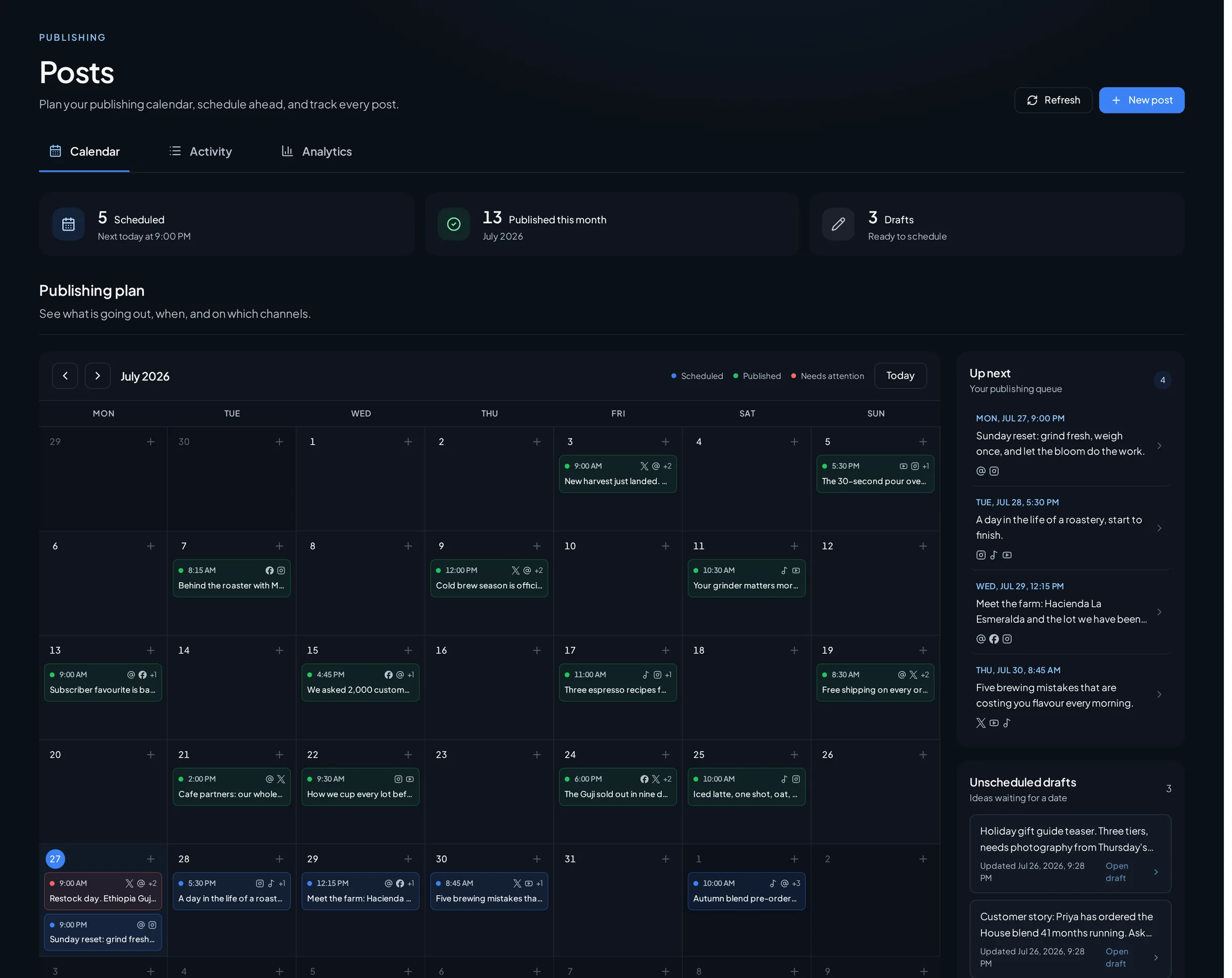
The output is a week of planned posts for Instagram, Threads and X — each one with a role and a date already attached, not a pile of undated ideas. The job is the generator: it runs on a cadence you set and produces that week as drafts. This is the part that replaces the daily willpower problem. A cron job does not need to feel motivated on Thursday.
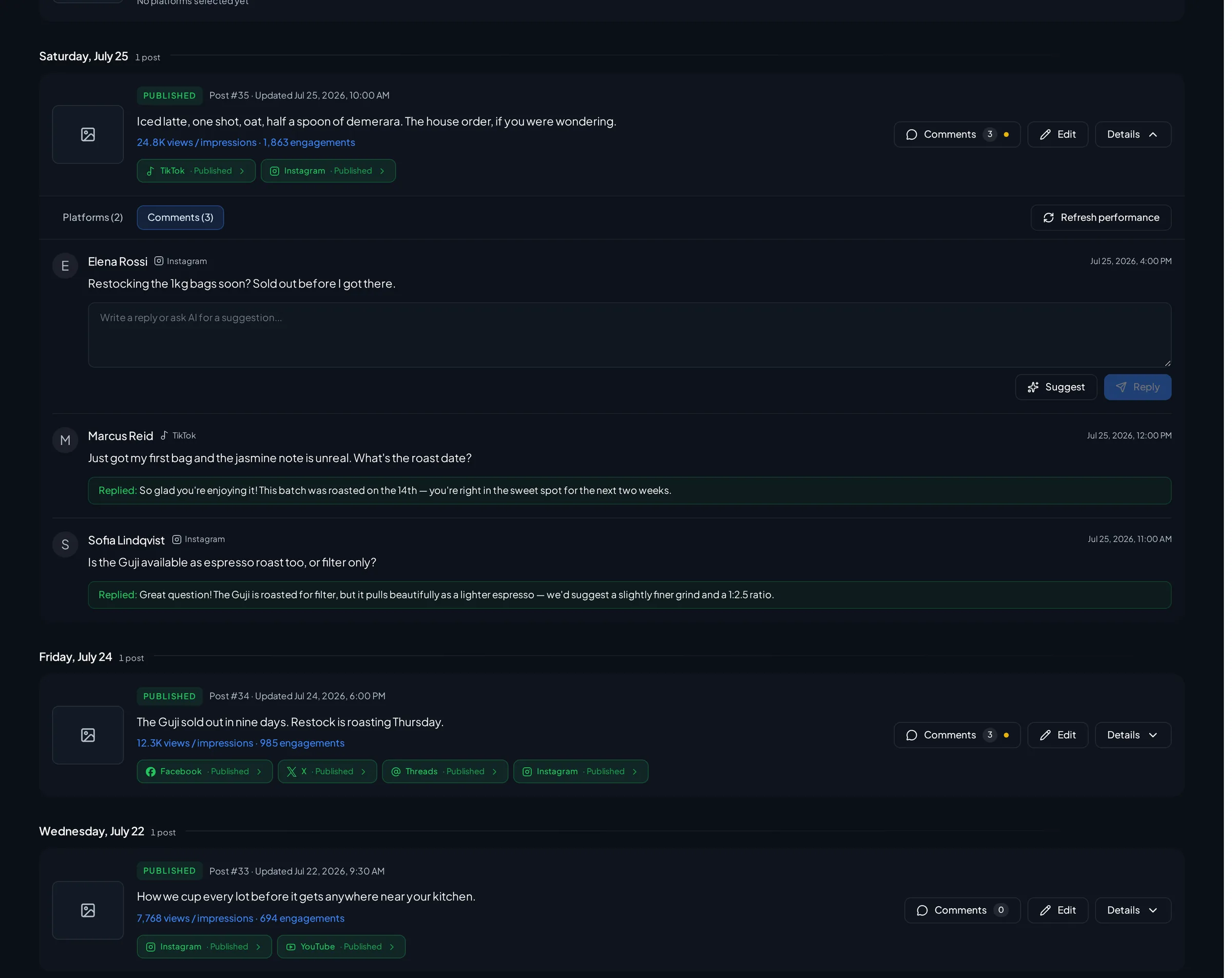
The logs are the rest. Each post has a per-destination publish status you can read like output from a queue worker: queued, publishing, published, failed. Comments arrive as a queue with drafted replies waiting for your edit. Performance is the metric that tunes the next run — you look at what earned replies and saves, and the next generated week leans that way. Nothing publishes without you approving it, which is the one manual step worth keeping.
The minimum viable marketing stack
The smallest set of parts that keeps distribution running without hiring anyone or building a habit you will drop in three weeks:
- A workspace generated from your live site, so the offer, the audience and the brand voice are stored once instead of re-explained every week.
- One generated week of posts on a fixed cadence, each with a role — teach, show, ship, ask — and a date already assigned.
- A composer with per-network preview and validation, so a post that breaks on X or fails Instagram media rules is caught before it reaches the queue.
- Brand templates rendered automatically, so a visual post does not mean opening a design tool and losing an evening.
- Per-destination publish status, so a failure is one line in a log you can retry, not a mystery about whether anything went out.
- A comment inbox with reviewed reply drafts, so replies are a queue you clear on a schedule instead of notifications that interrupt you all day.
One review session instead of daily posting
The cadence runs and a week of drafts appears. You open it once — Monday morning works, before you touch the codebase — and you review it as a batch. Reviewing seven posts together is a different task from writing one post seven times: you can see repetition, spot the one that sounds like a press release, and fix the sequence rather than the sentence. Twenty-five minutes is usually enough.
After approval, publishing is a scheduled job and the status view is your log. When a destination fails, it fails alone: the X post going out does not depend on the Instagram upload succeeding, and you fix one destination instead of re-running a launch. This is the difference between an incident and a bad afternoon.
Comments come back into the same workspace as a queue with drafted replies. You edit each one before it goes out, which takes minutes and keeps you sounding like a person. Then the performance view closes the loop: which post role earned replies, which format got saved, which day did nothing. You change one input — more of the role that worked — and the next generated week reflects it. That is tuning, not guessing, and it is the part that makes the whole thing tolerable.
The one-hour-per-week schedule
A schedule a developer can actually keep, because every block has a defined end state:
- Monday, 25 minutes: open the generated week, cut what is off, rewrite the one or two posts that do not sound like you, approve the rest.
- Monday, 10 minutes: check the queue. Every destination has a date and a status before you close the tab. Nothing is left in an unknown state.
- Wednesday, 15 minutes: clear the comment queue. Edit each drafted reply — one answer in your own words beats three generic ones.
- Friday, 10 minutes: read the performance view and write down one line about which post role earned attention this week.
- Whenever the product changes: update the site copy. The workspace reads from the site, so the input stays current without a separate content strategy document.
What a month of this realistically gets you
Four generated weeks, a dozen or two published posts across three networks, a log of exactly what shipped and what failed, a cleared comment queue, and a short list of post roles that reliably earn replies. That is a distribution system running on roughly four hours of your time. It is not a guarantee of sign-ups: traffic still depends on the product, the offer, and whether each post is worth reading.
The guardrail
Automate the scheduling, not the judgement. Nothing should publish unreviewed — a feed that runs entirely without you will sound like every other automated feed, and readers notice faster than you think. Keep the channel scope honest too: Amplispect publishes to Instagram, Threads and X. Reddit, LinkedIn, Product Hunt and Show HN stay manual work you do yourself, and they are better done manually anyway.
Go deeper
The rest of the distribution cluster, plus the product pages behind the workflow above:
- How Much Time Should a Solo Founder Spend on Marketing vs Building?How to split a solo founder week between shipping features and shipping distribution.
- Turn Your Landing Page Into 30 Days of Social PostsThe input side of the system: turning the copy you already wrote into a month of posts.
- How to Distribute an App: The Complete Guide for Founders Who Have Built SomethingThe full guide to distributing an app, from first users to a repeatable weekly loop.
- Your First 10 Posts About Your App When You Have No Users or TestimonialsConcrete post ideas for the first two weeks, when you have no audience and no case studies.
- Content Marketing Strategy for Your AppHow to build a content strategy that compounds instead of restarting every month.
- The content calendar generatorThe scheduled job itself: a week of planned posts with roles and dates, generated on your cadence.
- How Amplispect worksThe full loop from website to workspace to review to publish status and performance.
Frequently asked questions
How do developers market an app without hating it?
Replace the habit with a system. Store the inputs once (your site, offer and voice), let a scheduled job draft the week, review the batch in one sitting, and read the publish log and performance view instead of guessing. The parts developers dislike — performing, remembering, guessing — are all process problems, not marketing problems.
What is the minimum viable marketing stack for an indie hacker?
A workspace built from your site, a generator that produces a planned week for the networks you actually publish to, a composer with per-network validation, per-destination publish status, and a comment queue with reviewed replies. Anything beyond that is optional until you have a repeatable week.
Do I need to make videos or show my face to market my app?
No. Text and rendered brand templates carry most of what an early app needs: what you shipped, what problem it solves, what you learned building it. Video helps on some networks, but it is a format choice, not a requirement for having distribution at all.
Can app marketing be automated for a solo developer?
The scheduling, drafting and status tracking can be. The judgement should not be. Amplispect generates and queues, but nothing goes out until you approve it, and reply drafts are edited before they are sent. That review step is what keeps the account sounding like a person rather than a feed.