
About this case study
This guide describes a repeatable posting process, not a reported customer result — no cadence can promise sign-ups.
Why most build-in-public advice grows followers, not users
Building in public works. The version of it that circulates as advice mostly does not. The advice optimises for the one metric anyone can see from the outside — follower count — because that is the number screenshots are made of. So the recommended posts are the ones that travel: hot takes, revenue charts, thread hooks about consistency. They collect an audience of people who enjoy posts about building, and almost none of that audience has the problem your app solves.
In 2026 the gap is wider than it used to be. You can ship a working app with Lovable, Bolt, Cursor, v0 or Replit in a weekend, and thousands of people do. Build-in-public timelines are now full of founders narrating the same weekend. Being visible in that stream is no longer scarce. Being useful to one specific person with one specific problem still is.
A cadence that gets users looks different from one that gets followers. It talks about the problem more than the process. It shows the product doing the job more than it shows the founder at work. And it asks for something — a test, a reply, an email address — often enough that readers know what you actually want from them. The rest of this guide is that cadence: five post types, a weekly rhythm across Threads, X and Instagram, and one rule that keeps the whole thing pointed at acquisition.
The five post types, and what to write in each
Every post you publish should be recognisable as one of these five. Rotate them so that no week is five progress updates in a row:
- Problem. Describe the situation your app exists for, in the words your users would use, with no product mention at all. Prompt: “The worst part of reconciling invoices is not the maths, it is not knowing which client already paid. Here is what that looks like on a Tuesday morning.”
- Progress. Show one thing you shipped this week and why it matters to a user, not why it was hard to build. Prompt: “Shipped bulk import. Before, you pasted rows one at a time. Now you drop in a CSV and it is done.”
- Proof. Show the product doing the job — a short screen recording, a before and after, a real output with real data. This is the post that converts the reader who has been lurking for three weeks. Prompt: “Messy spreadsheet in, clean invoice list out. Forty seconds, unedited.”
- Ask. Request one small, specific action from one specific kind of person. Prompt: “If you invoice more than twenty clients a month, reply and I will import your last quarter this week so you can tell me where it breaks.”
- Lesson. What you got wrong and what changed because of it. This is the type that earns trust, and it only works when the mistake is real. Prompt: “I spent three weeks on a dashboard nobody opened. What people actually wanted was one weekly email.”
A weekly rhythm across Threads, X and Instagram
Each network does a different job in this rotation. Threads rewards conversation, so problem and lesson posts land there and replies are cheap to start. X is where other founders and early adopters follow links, so proof and progress belong there. Instagram carries visual progress: a screen recording, a before-and-after frame, a template card. Those are the three networks Amplispect publishes to. Anything else — Reddit, LinkedIn, a newsletter — is manual work you do on top, and it is fine to skip it while the cadence is still new.
The schedule itself is deliberately boring. Monday: problem, on Threads and X. Wednesday: progress, on X, plus Instagram when there is something worth looking at. Thursday: proof, on X and Instagram. Friday: the ask, on Threads and X. Sunday: lesson, on Threads. Five posts, three networks, one of each type, and roughly nine slots filled once you count the cross-posts.
Two things make that survivable for one person. The first is that a single idea is reshaped per network rather than written five times — the Thursday proof is one recording with a different first line on X than on Instagram. The second is that the week is planned as a week. Deciding on Monday what Friday will say is a ten-minute decision; deciding it on Friday at 6pm is the reason most build-in-public accounts go quiet after six weeks.
The rule that separates this from follower farming: every week contains exactly one post that asks for a specific action from a specific person. Not “check it out” — “if you run a store with more than 200 products, reply and I will import your catalogue and show you what it looks like.” One ask a week is frequent enough that people know you want users, and rare enough that the other four posts do not read as setup for a pitch. If a week goes by without an ask, that week produced followers.
Generate, review and schedule the week in one sitting
The cadence only survives if planning it takes under an hour. In Amplispect that sitting looks like this:
- Point the workspace at your app website once. It reads the offer, the audience and the brand voice, so generated drafts already talk about your product instead of a generic SaaS.
- Set the autopilot cadence to five posts a week. Each planned post arrives with a role and a date, which is exactly what a five-type rotation needs in order to hold.
- Open the composer and rewrite. The generator hands you a shaped week; the specifics — the Tuesday-morning detail, the number, the name of the workaround people use today — come from you.
- Check the per-network preview before scheduling. A Threads post that reads well can be truncated on X, and Instagram needs an image; validation catches that in the composer rather than at publish time.
- Find the Friday post and confirm the ask. It should name one situation and one action. If it says “check it out”, rewrite it before you go any further.
- Schedule all five, then check the per-destination publish status once mid-week instead of watching three apps daily.
Let replies and performance choose next week’s mix
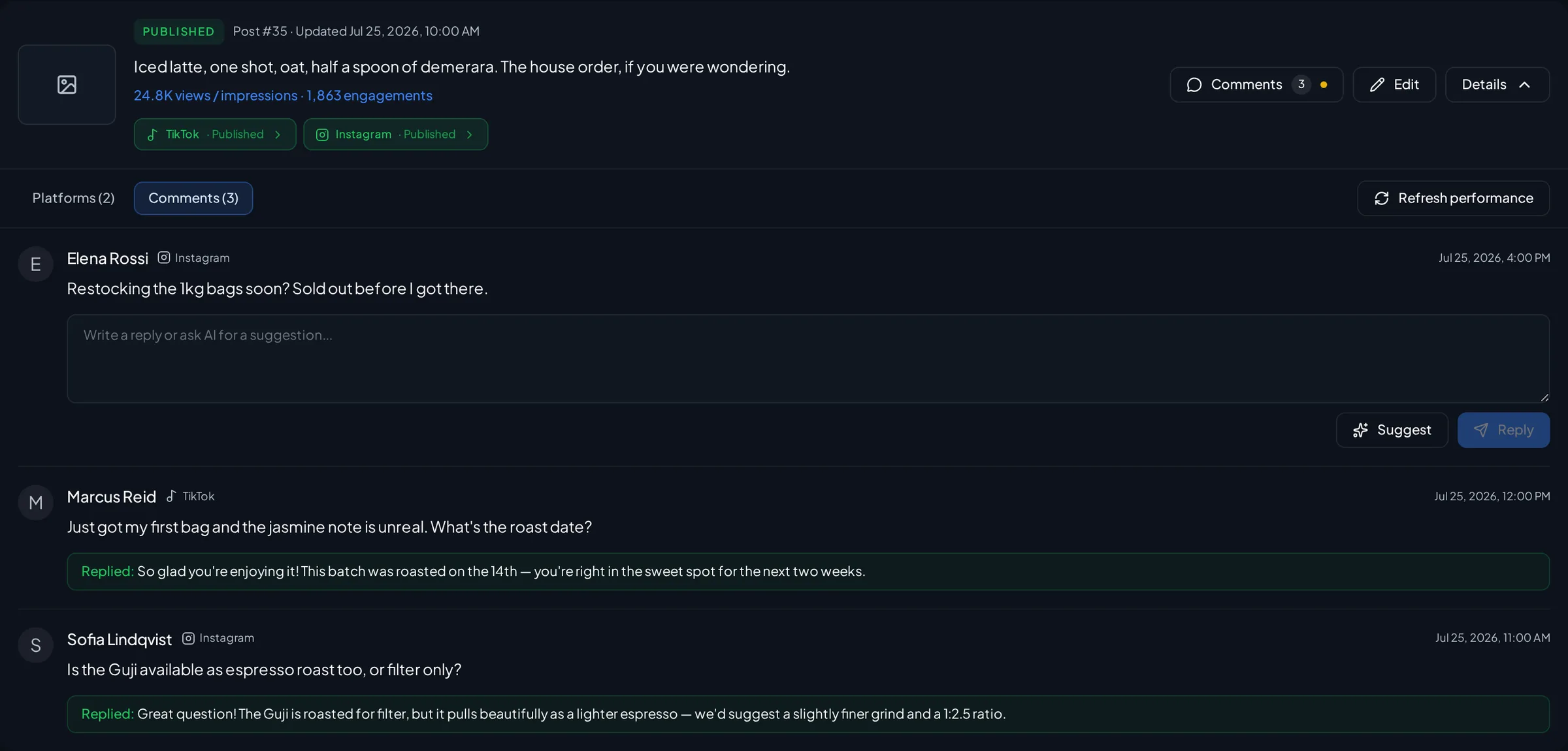
The point of the ask is the reply. When someone answers it, they have described their situation in their own words and volunteered to be a first user, which makes that thread more valuable than the week’s entire impression count. Supported comments sync back into the workspace and a response is drafted for you, but nothing is sent until you edit and approve it. That is deliberate: this is a first conversation with a potential user and it should not read as automated.
Performance decides the mix. At the end of the week, look at two things per post — how far it reached, and whether anyone did the thing. A problem post with wide reach and no replies tells you the problem is recognisable but you never asked. A proof post with modest reach and three replies is worth more than the rest of the week combined. The performance view feeds the next generated week, so the post types that earn conversations come back more often.
Adjust in small steps. If proof posts consistently beat progress posts, run two proof posts and drop one progress post. If a network produces nothing but silence for a month, cut it to one post a week. Never drop the ask, and give any change three weeks before judging it — at this scale a single week of numbers is mostly noise.
What this realistically produces
After a month you have roughly twenty published posts, a rotation you can plan in under an hour a week, four ask posts that produced named conversations instead of likes, and a written record of which problem statements people recognised. That is a distribution habit, not a growth chart. Your follower count may rise slowly or barely move; the number worth watching is how many people replied to an ask and then actually used the product.
The guardrail
Building in public is not a licence to publish everything. Keep customer data out of screenshots, do not post revenue figures you would regret being permanent, and do not announce a roadmap you cannot keep. And do not let the cadence run itself: nothing publishes without your review, and the ask post in particular should be written by you every week, because the specific thing it names is the whole reason it works.
Go deeper
The rest of the build-in-public and distribution cluster:
- Build in Public Content Calendar Template: A Repeatable 4-Week PlanA filled-in calendar for the five post types, if you would rather start from a template than a blank week.
- Typefully vs Amplispect for Build-in-Public FoundersHow a thread-first writing tool and a full distribution workspace differ once Instagram and replies are part of the job.
- How to Write a Changelog That Brings Users Back (and Attracts New Ones)Turn the release notes you already write into the progress posts in this rotation.
- Your First 10 Posts About Your App When You Have No Users or TestimonialsWhat to publish before you have a cadence, while the account is still empty.
- How to Distribute an App: The Complete Guide for Founders Who Have Built SomethingThe full distribution guide that this cadence is one part of.
- Instagram, Threads and X schedulerSchedule the week to all three networks with per-network previews and per-destination publish status.
- Brand template generatorRenders the visual progress posts on brand, so Instagram is never the reason a week slips.
Frequently asked questions
What is a good build in public posting schedule?
Five posts a week is a realistic ceiling for a solo founder: a problem post on Monday, progress on Wednesday, proof on Thursday, an ask on Friday and a lesson on Sunday. Consistency matters more than volume, so pick a number you can hold for three months.
What should I post about when building in public?
Rotate five types: the problem your app solves, what you shipped, proof of it working, a specific ask, and a lesson from something that went wrong. Problem and proof posts do most of the acquisition work; progress posts alone mostly reach other builders.
Does building in public actually get you users?
It can, but only when the posts describe the problem your users have and ask them to do something. A timeline of build updates reaches people who like build updates. The ask post is what converts an audience into conversations you can follow up on.
Which platforms are best for building in public?
Threads for conversation, X for links and other founders, Instagram for visual progress. Amplispect publishes to those three. Reddit, LinkedIn and newsletters can work well too, but they are manual work you add on top once the core cadence is steady.